
How to select a dosing pump — by LPH and pressure
Short answer: You need three things to select a dosing pump — how much chemical you are injecting (LPH), the line pressure (kg/cm²), and which chemical it is. For most RO plants a 6 LPH or 10 LPH pump is more than enough, because the actual dosing rate is only a few hundred millilitres per hour.
The most common mistake is buying a pump that is far too large. For a 1,000 LPH RO plant even a 6 LPH pump is oversized — you end up running it at 1 percent stroke, where accuracy falls apart.
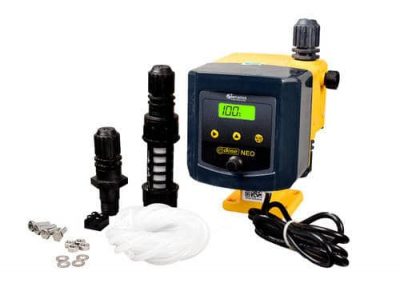
Step 1: Calculate the chemical requirement
Pump capacity is worked out on the solution you make up, not on the neat chemical. The formula:
Example: 1,000 LPH feed, antiscalant at 4 ppm, made up as a 10 percent solution:
(1,000 × 4) ÷ (10 × 10,000) = 4,000 ÷ 1,00,000 = 0.04 LPH, which is only 40 ml per hour.
So even a 6 LPH pump is large for this duty — it would run at roughly 1 percent stroke. This is exactly why the solution is diluted further, so the pump can work within a sensible range.
Step 2: Check the pressure
The pump rating must be higher than the line pressure, otherwise no chemical will go in at all.
| Injection point | Line pressure | Pump required |
|---|---|---|
| Feed tank (open) | 0 | 4 kg/cm² is fine |
| Before the pre-filter | 1 – 2 kg/cm² | 4 kg/cm² |
| Before the HP pump | 2 – 3 kg/cm² | 4 kg/cm² |
| After the HP pump (membrane line) | 10 – 15 kg/cm² | Edose HP |
| Boiler feed line | 10 – 20 kg/cm² | High pressure model |
Step 3: Material — standard or PVDF
| Chemical | Material |
|---|---|
| Antiscalant, SMBS, alkali | Standard PP — economical |
| Sodium hypochlorite | PP works, PVDF lasts longer |
| Sulphuric acid 98%, HCl | PVDF essential |
| Boiler chemicals (amine) | Standard PP |
PVDF costs roughly twice as much — the Edose NEO 6LPH is ₹6,090 while the NEO 6LPH PVDF is ₹14,700. But a standard pump on an acid line fails within a few months, so this is not a place to economise.
The Edose range — which model for what
| Model | Capacity | Suited to | Price |
|---|---|---|---|
| Edose 6LPH | 6 LPH @ 4kg | Basic, small RO | ₹5,460 |
| Edose 10LPH | 10 LPH @ 4kg | Basic, larger RO | ₹6,405 |
| Edose NEO 6LPH | 6 LPH @ 4kg | Better build | ₹6,090 |
| Edose NEO 10LPH | 10 LPH @ 4kg | The most common choice | ₹7,035 |
| NEO PRO 10LPH | 10 LPH + level switch | Automatic protection | ₹15,750 |
| Edose HP | 10 LPH @ 10kg | High pressure lines | ₹28,875 |
| Edose MAX 25LPH | 25 LPH motorised | Large industrial | ₹25,725 |
| Edose MAX 100 | 100 LPH, 3 phase | ETP / STP | ₹38,325 |
The complete list is in Edose metering pumps — over 38 models.
Solenoid or motorised
- Solenoid (6–10 LPH): compact, economical, very low power consumption. This covers around 90 percent of RO plants. An electromagnet drives the diaphragm.
- Motorised (25 LPH and above): driven by a motor, built for heavy continuous duty. Used in ETP, STP and large plants.
Three common mistakes
- Oversizing the pump: below about 10 percent stroke, accuracy deteriorates badly. Dilute the solution further so the pump runs at 30 to 70 percent stroke.
- Under-rating the pressure: if line pressure exceeds the pump rating, no chemical goes in — and you will not know it has stopped.
- Standard pump on acid: the diaphragm and valves fail within weeks. Only PVDF should be used.
What else you will need
- LLDPE dosing vessel, 10 litre (₹2,835) or 15 litre (₹3,465) for making up the solution
- Level switch (₹1,050) — stops the pump when the tank empties and prevents dry running
- Rotameter — you cannot calculate a dose without knowing the feed flow
Let us size your dosing pump
Send your feed flow in LPH, the dose in ppm, the chemical and your line pressure — we will do the calculation and recommend the correct model.
💬 WhatsApp par poochhein 📞 9910646957Frequently asked questions
What size dosing pump does an RO plant need?
For most RO plants a six or ten LPH pump is sufficient. The actual dosing rate is usually only a few hundred millilitres per hour, so a larger pump gives no benefit and in fact causes problems, because accuracy suffers badly at very low stroke settings.
What pressure rating should a dosing pump have?
Higher than the line pressure at the injection point. For a feed tank or pre-filter line a standard four kg per cm2 pump is adequate. After the high pressure pump, or on a boiler feed line, a ten to fifteen kg model is needed.
When is a PVDF pump necessary?
When the chemical is aggressive, such as ninety eight percent sulphuric acid or hydrochloric acid. A standard polypropylene pump fails within weeks in those conditions. For antiscalant, SMBS and alkali a standard pump is perfectly adequate.
What is the difference between solenoid and motorised dosing pumps?
In a solenoid pump an electromagnet drives the diaphragm; these are compact, economical and available up to about ten LPH. Motorised pumps are driven by a motor, start at around twenty five LPH and are built for heavy continuous duty.
Can one pump dose two different chemicals?
No, each chemical needs its own pump. Mixing chemicals can cause a reaction that destroys the effect of both. For two chemicals there are dual models available with two separate dosing heads.