
Dry run protection — what it is and why it matters
Short answer: Dry running means the pump operating without water. Water is what keeps a pump cool and its seal lubricated. Without it a pump overheats within minutes and destroys its seal, and shortly after that the motor. Protection costs as little as a ₹546 pressure switch or a ₹604 level switch.
It is a very small cost that protects a pump worth thousands — yet most plants do not have it fitted.
What actually happens during dry running
- 0–2 minutes: the pump starts heating, because there is no water to carry heat away
- 2–5 minutes: the rubber of the mechanical seal begins to burn — the first real damage
- 5–15 minutes: the seal fails completely and leaking starts
- 15+ minutes: impeller and casing begin to rub, and the motor goes into overload
- Beyond that: the motor winding burns out — the pump is finished
Why dry running happens
- The feed tank empties and nobody notices
- The municipal supply stops
- The borewell water level drops
- Air enters the suction line
- Foot valve or strainer choked
- Inlet valve accidentally closed
- A timer starts the pump when the tank is empty
Three ways to protect
1. Level switch — in the tank
A float hangs in the tank. As soon as the level falls, the pump stops.
| Type | Cuts out when | Price |
|---|---|---|
| Black level switch (N.C.) | Level falls | ₹604 |
| White level switch (N.O.) | Level rises | ₹604 |
| FLOATY, 3 m wire | Level controller | ₹656 |
| FLOATY, 5 m wire | Level controller | ₹971 |
| FLOATY, 10 m wire | For distant tanks | ₹1,260 |
Advantage: the most direct method, stopping the pump before the tank empties. Limitation: wiring has to be run to the tank.
2. Low pressure switch — in the line
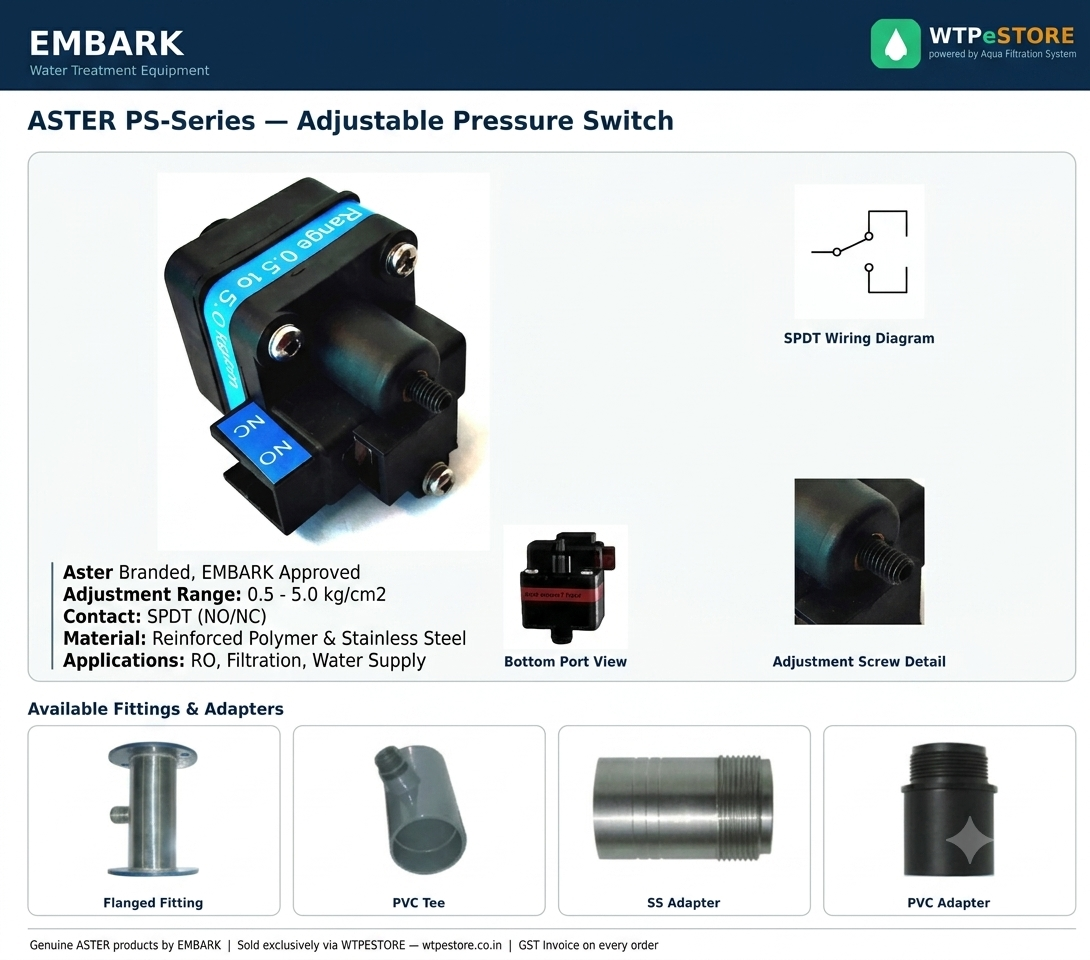
A low pressure switch (₹546) monitors suction pressure. If pressure falls, water is not arriving, and the pump stops.
Advantage: catches every cause, not just an empty tank — a choked foot valve, a closed valve, or a supply failure. Limitation: the setting has to be adjusted correctly.
For better quality, the LPS NXT metal body with adjustable set point (₹840) lets you set the cut-out yourself.
3. Panel built-in protection
Astero NXT panels include dry run protection, which senses from the current that the pump is running dry. But it only works when a switch is also connected.
The best arrangement — all three
| What to fit | What it protects against | Price |
|---|---|---|
| Level switch (feed tank) | Empty tank | ₹604 |
| Low pressure switch (suction) | Air, choked valve, supply failure | ₹546 |
| High pressure switch (discharge) | Membrane scaling, closed valve | ₹546 |
| NXT panel | Overload, voltage, phase | From ₹9,450 |
Setting them correctly
Level switch
Set the float at around 10 to 15 percent of tank height — low enough that the tank nearly empties, but not so low that air enters the suction pipe.
Low pressure switch
Set it 0.3 to 0.5 kg/cm² below normal running pressure. Set too close and the plant will keep stopping unnecessarily.
High pressure switch
Set it 2 to 3 kg/cm² above normal operating pressure. This protects the membrane and housing from excess pressure.
Auto-restart — yes or no
Some panels restart the pump automatically once water returns. This is useful where supply is intermittent and nobody is always present.
But be careful: if the underlying problem is a choked foot valve or blocked line, auto-restart will make the pump dry run again and again. So auto-restart should include a retry limit — for example three attempts and then a lockout, so somebody comes to investigate.
A two-minute weekly check
- Move the level switch up and down by hand — the pump should stop and start
- Confirm the pressure gauge readings are normal
- Listen for any change in the pump sound
This small habit prevents a great deal of expensive damage.
Protect your pump
A complete protection set costs about ₹1,700. Send your pump HP and tank distance and we will supply the right switches.
💬 WhatsApp par poochhein 📞 9910646957Frequently asked questions
What damage does dry running cause?
Water is what keeps a pump cool and its seal lubricated. Without it the mechanical seal starts burning within minutes, then leaking begins, and if it continues the motor winding itself can burn out.
What is needed for dry run protection?
A level switch in the feed tank and a low pressure switch on the suction line. Together they cost around twelve hundred rupees and protect a pump worth many thousands. The panel protection works in conjunction with these switches.
Which is better, a level switch or a pressure switch?
They do slightly different jobs. A level switch only responds to an empty tank, while a pressure switch catches every cause including a choked foot valve or a closed valve. Fitting both together is the best arrangement.
What setting should a low pressure switch have?
About point three to point five kg per cm2 below normal running pressure. Set too close the plant will stop unnecessarily, and set too far below the protection loses its purpose.
Should auto-restart be enabled?
It is useful where the supply is intermittent and nobody is always present. But it should include a retry limit, otherwise if the real problem is a choked line the pump will keep dry running repeatedly.