
Distribution systems — choosing hub and lateral assemblies
Short answer: The distribution system is what makes water pass evenly through the media bed. Without it water takes the shortest path, channels form, and most of the media never does any work. A vessel with a poor distribution system treats a fraction of the water it should.
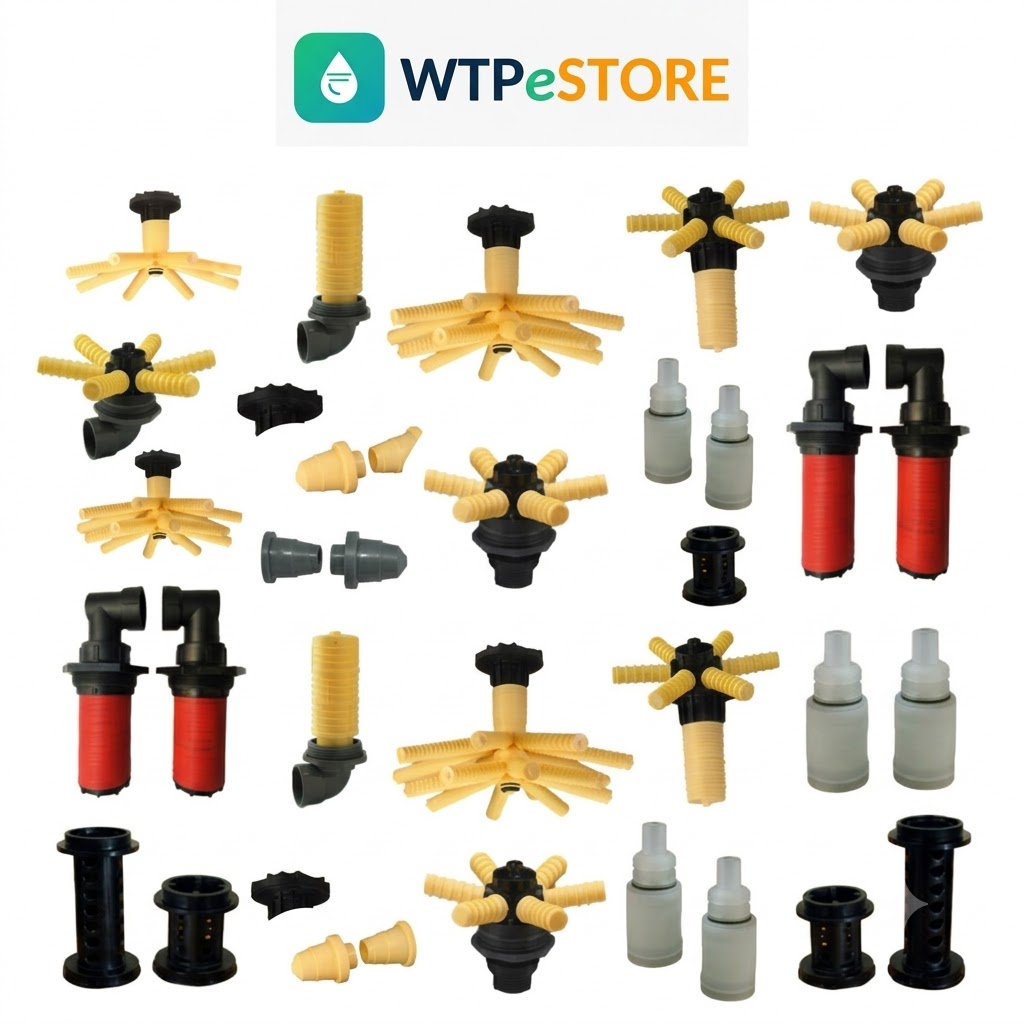
It consists of two parts — a top distributor that spreads incoming water across the bed, and bottom laterals that collect treated water evenly from the base.
Why it matters
Imagine pouring water into the top of a vessel through a single pipe. It would drill straight down through the media in a narrow path, and the media on either side would never be touched.
That is channelling, and its effects are:
- A softener stops removing hardness long before its rated capacity
- A filter passes turbidity through untreated
- Backwash cannot clean the bed evenly
- Media life is shortened
The two parts
Top distributor
Sits at the top of the riser pipe and spreads incoming water across the full diameter of the vessel, rather than letting it fall in one stream.
Bottom laterals
Slotted pipes radiating from a hub at the base. They collect treated water evenly from the whole bed area, and during backwash they distribute water evenly upward.
Options and prices
| Item | Application | Price |
|---|---|---|
| RM ST1101 top distribution | Top distributor | ₹788 |
| RM ST6101, 6 long laterals | Bottom laterals, medium vessels | ₹2,520 |
| RM ST6102, 12 laterals | Bottom laterals, larger vessels | ₹3,150 |
| Double strainer, 6 m³/hr | Up to 6,000 LPH | ₹1,050 |
| Double strainer, 12 m³/hr | Up to 12,000 LPH | ₹1,575 |
| GP-4R2-63 with basket (63 mm) | 63 mm connection | ₹761 |
| GP-4R2-50U with basket (50 mm) | 50 mm connection | ₹1,050 |
| 6450 hub and lateral | For a 2472 vessel | ₹1,575 |
| 6600 hub and lateral | For a 3072 vessel | ₹1,575 |
The full list is in Distribution Systems.
Choosing by vessel size
| Vessel | Typical arrangement |
|---|---|
| 0844 – 1054 | Top distributor plus a simple basket strainer |
| 1354 – 1665 | Top distributor plus 6 laterals |
| 1865 – 2160 | Top distributor plus 12 laterals |
| 2469 – 2472 | Hub and lateral system (6450) |
| 3072 and above | Hub and lateral system (6600) |
Choosing by flow
Flow also matters, because the distributor must pass your flow without excessive pressure drop:
- Up to 6 m³/hr (6,000 LPH) — the 6 m³/hr double strainer
- Up to 12 m³/hr (12,000 LPH) — the 12 m³/hr double strainer
- Above that — hub and lateral systems
Slot size matters
The laterals have slots, and the slot width must be smaller than the media particles, otherwise media passes through into the treated water.
| Media | Slot requirement |
|---|---|
| Softener resin | Fine slots, or gravel underneath |
| Sand / multigrade | Standard slots with gravel |
| Activated carbon | Fine slots, carbon is friable |
In practice a graded gravel bed under the media solves this, which is why gravel layering is not optional. See our media loading guide.
Installation points
- Fit the laterals before loading media — obvious, but they must also be checked for damage first
- Tape the riser — cover the top of the riser pipe so media cannot fall inside during loading
- Half fill with water first — this cushions the media and protects the laterals
- Riser must be central and vertical — an off-centre riser gives uneven distribution
- Check lateral orientation — slots should face downward or sideways as designed, not upward
Signs of a distribution problem
- Softener capacity far below rating — the classic sign of channelling
- Media in the treated water — a lateral is broken or the slots are too wide
- Backwash water not clearing — uneven upward flow
- High pressure drop even with clean media
- Hardness breaking through early after each regeneration
If you see these, the vessel needs opening and the internals inspecting.
A common false economy
People sometimes fit an undersized or improvised distributor to save a few hundred rupees. The result is a vessel that treats perhaps half the water it should — so the media, the vessel and the valve are all working at half value.
A proper distribution system costs between ₹788 and ₹3,150 against a vessel and media costing far more. It is not a sensible place to economise.
Get the right distribution system
Send your vessel size, flow and media type, and we will specify the correct distributor and laterals.
💬 WhatsApp par poochhein 📞 9910646957Frequently asked questions
What does a distribution system do inside a vessel?
It makes water pass evenly through the media bed. The top distributor spreads incoming water across the full diameter, and the bottom laterals collect treated water evenly from the base. Without it water channels through a narrow path and most of the media does no work.
What is channelling and why is it a problem?
Channelling is water finding a short path through the media instead of passing through all of it. A softener then stops removing hardness long before its rated capacity, and a filter passes turbidity untreated, while everything looks normal from outside.
Which distribution system suits my vessel?
Smaller vessels up to 1054 use a top distributor with a basket strainer, medium vessels use six laterals, larger ones twelve laterals, and vessels of 2472 and above use a hub and lateral system. Flow also has to be checked.
Why does slot size matter on the laterals?
The slots must be smaller than the media particles, otherwise media passes into the treated water. In practice a graded gravel bed underneath the media solves this, which is why gravel layering should never be skipped.
How do I know if there is a distribution problem?
Softener capacity far below its rating is the classic sign, along with hardness breaking through early after regeneration. Media in the treated water indicates a broken lateral or slots that are too wide.