
DM plant vs RO plant — which do you need
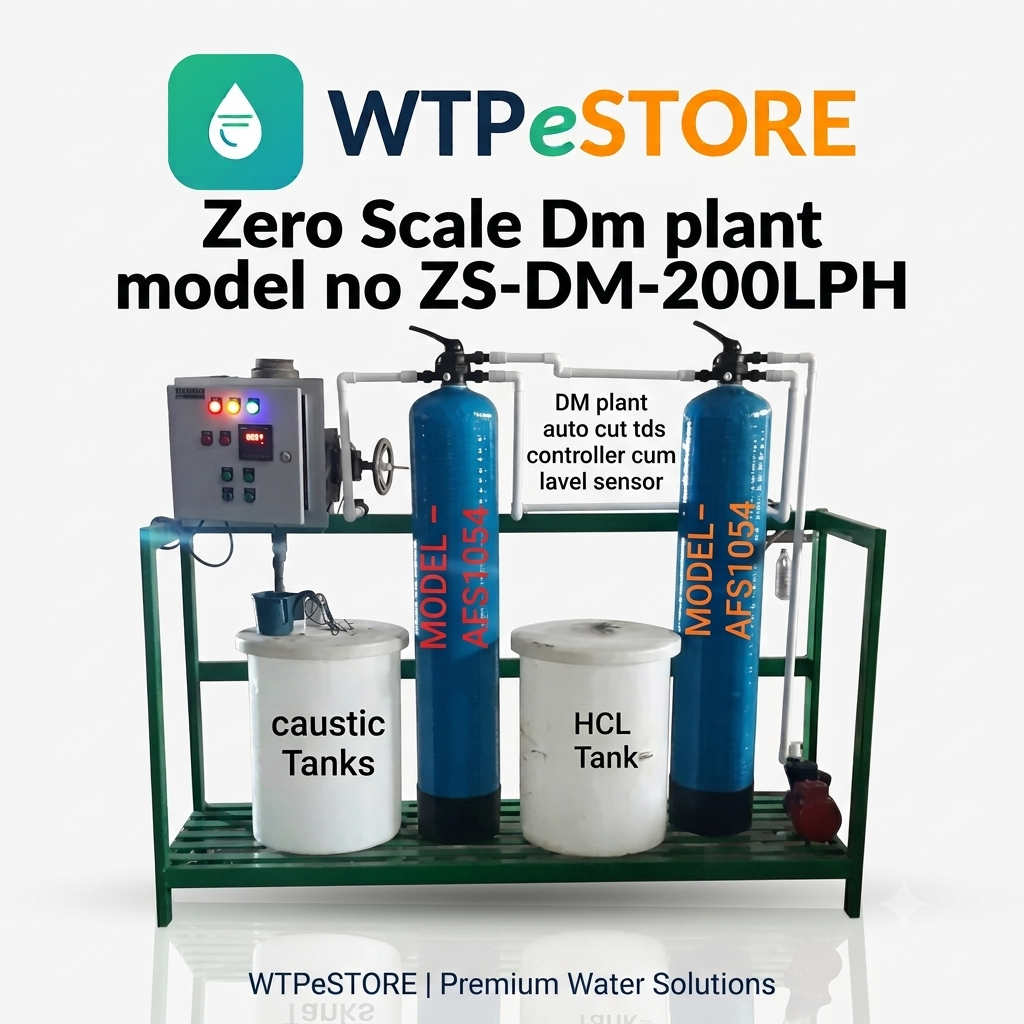
Short answer: RO removes 95 to 98 percent of dissolved salts using pressure and a membrane. DM (demineralisation) uses ion exchange resins to remove essentially all ionic salts, producing water of very low conductivity.
DM produces purer water but has a higher running cost because the resins need regenerating with acid and alkali. Which is why many plants use RO followed by DM — the RO removes the bulk, and the DM polishes.
How each works
RO
Pressure forces water through a semi-permeable membrane. Salts are rejected and leave with the reject stream. Typical permeate is 10 to 50 ppm TDS.
DM
Water passes through cation resin which exchanges positive ions for hydrogen, then anion resin which exchanges negative ions for hydroxide. The hydrogen and hydroxide combine to form water. Output conductivity can be below 1 µS/cm.
Comparison
| Feature | RO | DM |
|---|---|---|
| Output quality | 10 – 50 ppm TDS | Below 1 ppm |
| Salt removal | 95 – 98% | Essentially complete |
| Water recovery | 50 – 75% | 90 – 95% |
| Power consumption | High (HP pump) | Low |
| Chemical consumption | Low (antiscalant, SMBS) | High (acid and alkali) |
| Removes bacteria | Yes | No |
| Removes organics | Yes | Partly |
| Running cost on high TDS | Moderate | Very high |
| Effluent | Reject water | Acid and alkali regeneration waste |
The running cost point
This is precisely why RO is used ahead of DM. The RO reduces TDS from 1,500 to perhaps 30, and the DM then removes that last 30 ppm with far less chemical — often regenerating monthly instead of daily.
When RO alone is enough
- Drinking water and packaged water
- General process water
- Low pressure boiler feed
- Cooling tower make-up
- Anywhere 10 to 50 ppm TDS is acceptable
When DM is needed
- High pressure boilers — requiring very low conductivity feed
- Pharmaceutical water systems
- Laboratory reagent water
- Electronics and semiconductor rinsing
- Battery manufacturing
- Any process specifying conductivity below about 5 µS/cm
The combined arrangement
RO followed by DM is the standard approach for high purity applications:
- Pre-treatment
- RO — removes 95 to 98 percent of salts
- DM (mixed bed or two bed) — polishes to below 1 ppm
- Conductivity monitoring on the outlet
The benefit: DM regeneration frequency falls dramatically, so acid and alkali consumption and the associated effluent both reduce substantially.
Two bed or mixed bed
| Two bed | Mixed bed | |
|---|---|---|
| Arrangement | Separate cation and anion vessels | Both resins mixed in one vessel |
| Output quality | Good (1 – 10 µS/cm) | Excellent (below 1 µS/cm) |
| Regeneration | Simpler | More complex — resins must be separated first |
| Typical use | Bulk demineralisation | Final polishing |
A common arrangement is two bed for the bulk work followed by mixed bed for polishing.
Monitoring a DM plant
Conductivity is the key measurement, and the values are very low — so a conductivity meter, not a TDS meter, is appropriate.
- CI 350 — from 0.05 µS/cm, ₹2,730
- CT 650 with relay — ₹5,880, so the outlet can be diverted automatically when quality falls
See our TDS vs conductivity guide.
Safety with DM regeneration
Choosing between them
| Requirement | Solution |
|---|---|
| Drinking water | RO |
| Low pressure boiler | Softener, or RO |
| High pressure boiler | RO plus DM |
| Pharma or laboratory | RO plus mixed bed DM |
| Process water, moderate purity | RO |
| Electronics rinsing | RO plus mixed bed DM |
Tell us the conductivity specification your process requires and your feed water analysis, and we will advise which arrangement suits.
RO, DM or both?
Send your required outlet conductivity and feed water analysis, and we will recommend the right arrangement.
💬 WhatsApp par poochhein 📞 9910646957Frequently asked questions
What is the difference between a DM plant and an RO plant?
RO uses pressure and a membrane to remove ninety five to ninety eight percent of dissolved salts. DM uses ion exchange resins to remove essentially all ionic salts, producing water below one ppm but at a higher chemical running cost.
Why is DM expensive to run on high TDS water?
Because every ion removed consumes regeneration chemical. On high TDS feed the resins need frequent regeneration with acid and alkali, so chemical consumption and effluent volume both become very high.
Why is RO used before DM?
The RO reduces TDS from perhaps fifteen hundred to thirty ppm, so the DM only has to remove that last small amount. Regeneration frequency falls dramatically, which cuts acid and alkali consumption and effluent.
What is the difference between two bed and mixed bed DM?
Two bed uses separate cation and anion vessels and gives one to ten microsiemens. Mixed bed has both resins in one vessel and gives below one microsiemens, but regeneration is more complex because the resins must be separated first.
Does a DM plant remove bacteria?
No. DM removes ionic salts but not bacteria, and resin beds can actually harbour bacterial growth. Where microbiological quality matters, separate disinfection is needed.