
TDS meter vs conductivity meter — what is the difference
Short answer: Both measure the same thing — dissolved salts in water. A conductivity meter measures electrical conductance directly, in µS/cm, and a TDS meter multiplies that same reading by a factor to display it in ppm. So a TDS meter is a conductivity meter with a calculation added.
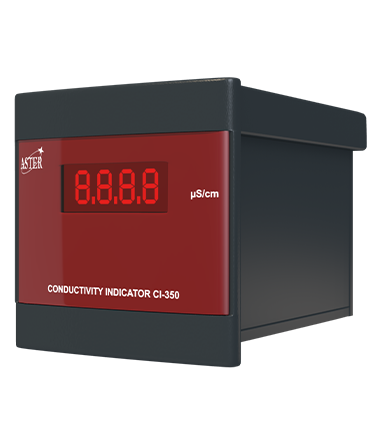
That is why both cost roughly the same — the TDS Meter TI 350 is ₹2,730 and so is the Conductivity Meter CI 350.
Understanding the difference
Pure water does not conduct electricity. Once salts dissolve in it, it begins to conduct — the more salts, the higher the conductivity.
| Conductivity | TDS | |
|---|---|---|
| What it measures | Ability to conduct electricity | Total dissolved solids |
| Unit | µS/cm (microsiemens) | ppm or mg/L |
| How it is obtained | Measured directly | Conductivity × factor |
| Where it is used | Industry, DM plant, boiler | Drinking water, RO |
A factor of 0.65 is commonly used, so 1,000 µS/cm is roughly 650 ppm TDS.
Why the factor varies from 0.5 to 0.7
Because different salts conduct differently. Sodium chloride conducts more, calcium carbonate less. So the factor shifts depending on which salts dominate in your water.
What this means in practice: the number on a TDS meter is an approximation, not an exact figure. A laboratory report may show a different TDS — that is normal and does not mean the meter is faulty.
Which one to choose
| Application | Choose | Reason |
|---|---|---|
| RO permeate (drinking water) | TDS meter | People understand ppm |
| RO feed line | TDS meter | For deciding recovery |
| DM plant outlet | Conductivity | Very low values, µS/cm is more suitable |
| Boiler water | Conductivity | For blowdown control |
| Cooling tower | Conductivity | Cycles of concentration |
| ETP outlet | Conductivity | Discharge norms |
The Aster range
| Model | Range | Function | Price |
|---|---|---|---|
| TDS Meter TI 350 | 2–999 ppm | Display only | ₹2,730 |
| Conductivity CI 350 | 0.05–999 | Display only | ₹2,730 |
| Conductivity CI 550L | Auto ranging, 0.5–9999 | Wide range | ₹3,885 |
| Conductivity Controller CT 650 | With relay | Displays and controls | ₹5,880 |
Meter or controller — an important distinction
- Meter (TI 350, CI 350): shows a reading only. You have to look at it.
- Controller (CT 650): reads and also operates a relay — for example stopping the plant or diverting water when TDS rises.
If you want poor quality water kept out of the tank automatically, you need a controller, not a meter. There is also the ROMATIC controller, which manages the whole RO plant.
CT 650 variants
| Version | Feature | Price |
|---|---|---|
| Basic with relay | General purpose | ₹5,880 |
| Temperature compensation | Correct reading in hot water | ₹7,980 |
| SS Tri Clover | Food and pharma fitting | ₹8,400 |
| 2 lakh range | Very high TDS (ETP, brine) | ₹9,450 |
Sensors are available separately
If the meter is fine but the sensor has failed, there is no need to replace the whole unit:
- Sensor for CI 350 / CI 550 — ₹1,155
- Sensor for CT 650 — ₹1,470
What readings are normal
| Water | TDS (ppm) | Conductivity (µS/cm) |
|---|---|---|
| RO permeate (good plant) | 10–50 | 15–80 |
| Drinking water (ideal) | 50–150 | 80–230 |
| Municipal supply | 200–500 | 300–770 |
| Borewell (typical) | 500–2,000 | 770–3,000 |
| Brackish borewell | 2,000–5,000 | 3,000–7,700 |
| DM water | <1 | <2 |
Calculating rejection
TDS tells you how well the RO plant is performing:
Example: feed 1,000 ppm, permeate 40 ppm → (1,000 − 40) ÷ 1,000 × 100 = 96 percent
A new membrane should give 96 to 98 percent. If it falls below 90 percent the membrane is nearing end of life — see our RO monitoring guide.
Two common mistakes
- Fitting a meter only on permeate — without feed TDS you cannot calculate rejection at all. Both are needed.
- Leaving the sensor in air — the sensor should stay immersed. Drying out shortens its life.
Choose the right meter
Tell us where it will be fitted and the expected range, and we will recommend the correct model and fitting.
💬 WhatsApp par poochhein 📞 9910646957Frequently asked questions
What is the difference between TDS and conductivity?
They measure the same property. Conductivity is measured directly as the ability of water to conduct electricity, while TDS is that same reading multiplied by a factor and displayed in ppm. So a TDS meter is essentially a conductivity meter with a calculation added.
How do I convert conductivity to TDS?
Multiply the conductivity by a factor of about zero point five to zero point seven. A factor of zero point six five is commonly used, so one thousand microsiemens is roughly six hundred and fifty ppm.
Should I use a TDS or a conductivity meter on an RO plant?
For drinking water plants a TDS meter is better because people understand ppm. For a DM plant, boiler or cooling tower a conductivity meter is preferable, because the values there are either very low or very high.
What is the difference between a meter and a controller?
A meter only displays a reading, which somebody has to look at. A controller has a relay that can stop the plant or divert water when the reading goes out of range, so poor quality water never reaches the tank.
When is temperature compensation necessary?
When the water temperature is well away from twenty five degrees, as in a boiler or cooling tower. Conductivity changes with temperature, so without compensation the reading will be misleading.