
How to decide the NB size of a flow meter
Short answer: The NB size of a flow meter should match your pipe line — neither smaller nor larger. NB stands for Nominal Bore, the approximate internal size of the pipe. 15NB is roughly half an inch, 20NB three-quarter inch and 25NB one inch.
There is one complication though: sometimes your line size and the size your flow actually requires are different. What to do in that case is the real subject of this guide.
NB to inch conversion chart
| NB | Inch | Typical use |
|---|---|---|
| 15NB | ½" | Small RO plants, dosing lines, domestic connections |
| 20NB | ¾" | Commercial RO, water ATM, small softener |
| 25NB | 1" | 1,000–3,000 LPH plants, softener feed |
| 40NB | 1½" | Industrial RO feed, filter lines |
| 50NB | 2" | Large plants, cooling tower make-up |
| 65NB | 2½" | Large industrial plants |
| 80NB | 3" | ETP/STP main lines |
| 100NB | 4" | Municipal, heavy industry |
| 150NB | 6" | Main supply lines |
Flow first or NB first?
This is the most common question, and the correct order is:
- Work out the flow first in LPH — this decides the model
- Then check the line NB — and choose that model in the matching NB
- If the two do not line up, read the next section
When NB and flow do not match
Case 1: Large line, low flow
For example a 25NB line carrying only 200 LPH. A 25NB rotameter would read at the very bottom of its scale and be useless. The fix: fit a smaller meter (15NB) with reducers on both sides. At such a low flow the reducers cause no meaningful problem.
Case 2: Small line, high flow
For example a 15NB line carrying 2,000 LPH. This is actually a problem with the pipework, not the meter — that much flow through such a small pipe creates very high velocity, which erodes the pipe, causes noise and loads the pump. Here the pipe should be changed before worrying about the meter.
Case 3: Flanged connection required
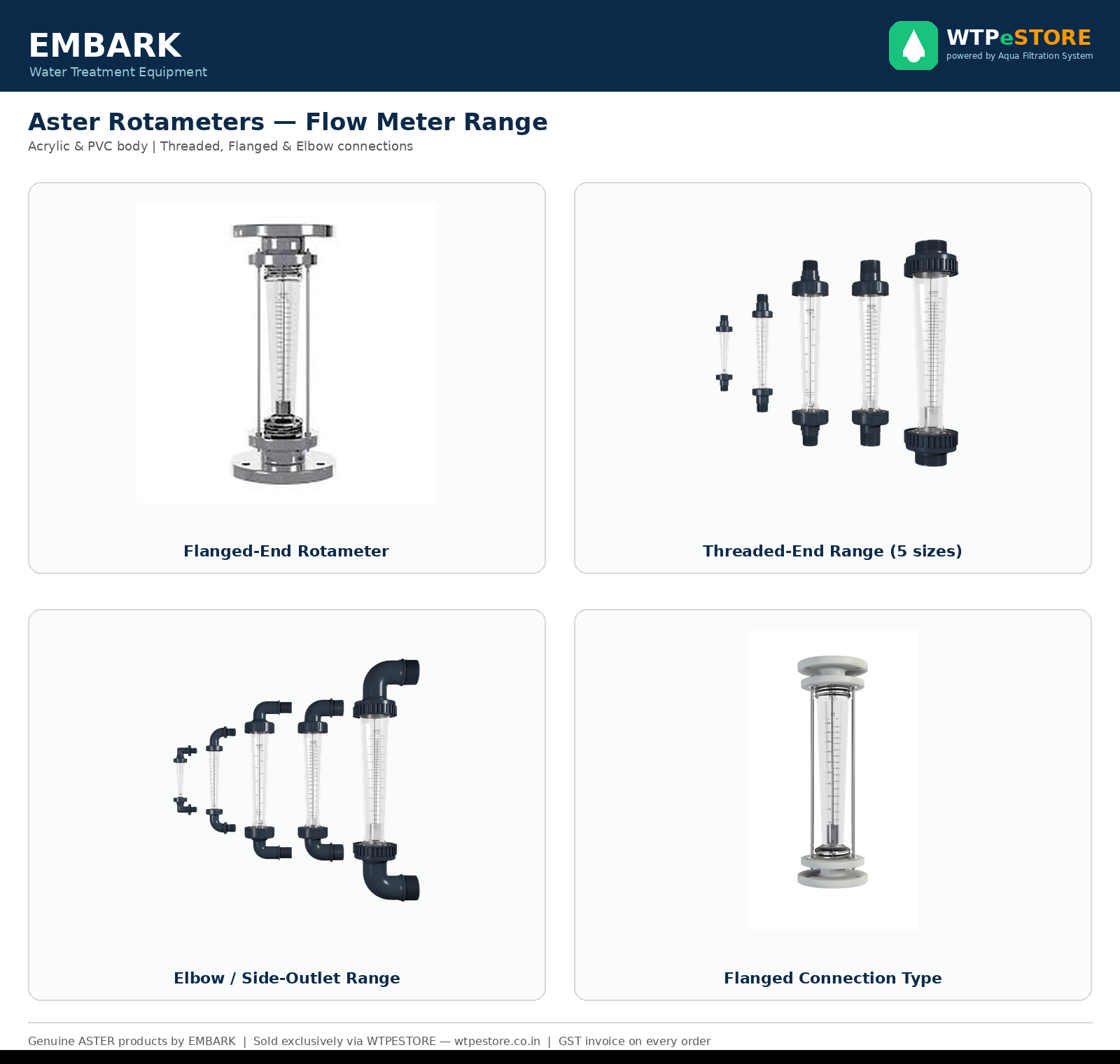
Larger plants use flanges rather than threads. Separate models exist for this, such as the 40NB flanged end connection version. Always state whether you need threaded or flanged when ordering.
A simple velocity check
A useful rule: water velocity in a pipe should stay between roughly 1 and 2.5 metres per second. Above that you get erosion and noise; below it you get settlement.
| Pipe size | Comfortable flow | Approx maximum |
|---|---|---|
| 15NB (½") | 500 – 1,200 LPH | ~1,800 LPH |
| 20NB (¾") | 1,000 – 2,500 LPH | ~3,500 LPH |
| 25NB (1") | 1,800 – 4,500 LPH | ~6,000 LPH |
| 40NB (1½") | 4,000 – 10,000 LPH | ~14,000 LPH |
| 50NB (2") | 7,000 – 18,000 LPH | ~25,000 LPH |
| 80NB (3") | 18,000 – 45,000 LPH | ~60,000 LPH |
These are approximate guides only. For proper sizing use our free plant calculators or send us the details on WhatsApp.
What goes wrong with the wrong NB
- Meter too large: the flow sits at the bottom of the scale, the reading is hard to take, and you have paid more for it
- Meter too small: pressure drop increases, the pump works harder, and the meter wears faster
- Reducer fitted badly: placing the meter immediately after a reducer means the water arrives swirling and the reading is unstable — straight pipe in between is essential
Four things to tell us when ordering
- Flow — in LPH or m³/hr
- Line NB — 15, 20, 25, 40, 50NB and so on
- Connection type — threaded (male/female) or flanged
- Liquid — normal water, RO permeate, raw water or chemical
With these four details we can send the correct model first time, with no returns and no delays.
Let us confirm your NB size
Send your flow and pipe size and we will confirm the correct NB, connection type and model, so the right item reaches you first time.
💬 WhatsApp par poochhein 📞 9910646957Frequently asked questions
What does NB stand for?
NB means nominal bore, which is the approximate internal size of the pipe. It is a standard size rather than an exact measurement. 15NB is roughly half an inch, 20NB three-quarter inch and 25NB one inch.
Can I fit a smaller flow meter on a larger line?
Yes, using reducers. This works well when the flow is low and you want the meter to read in the correct part of its scale. Just make sure there is at least five pipe diameters of straight line after the reducer, otherwise the reading will be unstable.
What is the difference between threaded and flanged connections?
A threaded meter screws into the pipe and is common in smaller sizes. A flanged meter has a circular plate at each end that bolts to matching flanges, which suits larger lines and higher pressures. Always state which one you need when ordering.
What water velocity should a pipe carry?
Roughly one to two and a half metres per second is considered acceptable. Higher velocity erodes the pipe and causes noise, while much lower velocity allows settlement. Pipe sizes are selected on this basis.
Should the flow meter NB match the pump size?
Not necessarily. It should match the NB of the section of pipe where the meter is fitted. Pump outlets are often a different size from the main line with a reducer in between, which is perfectly normal.