
PP spun vs string wound vs pleated — which is better
Short answer: PP spun is the standard — economical, entirely suitable for RO, and used in around 90 percent of plants. String wound is better for dirtier water because it holds more dirt. Pleated suits situations where the filter is washed and reused, or where very high flow is needed.
How each is made
PP spun (melt blown)
Fine polypropylene fibres are spun from molten material. The pores are coarser on the outside and finer inside, so dirt is retained throughout the thickness rather than only on the surface.
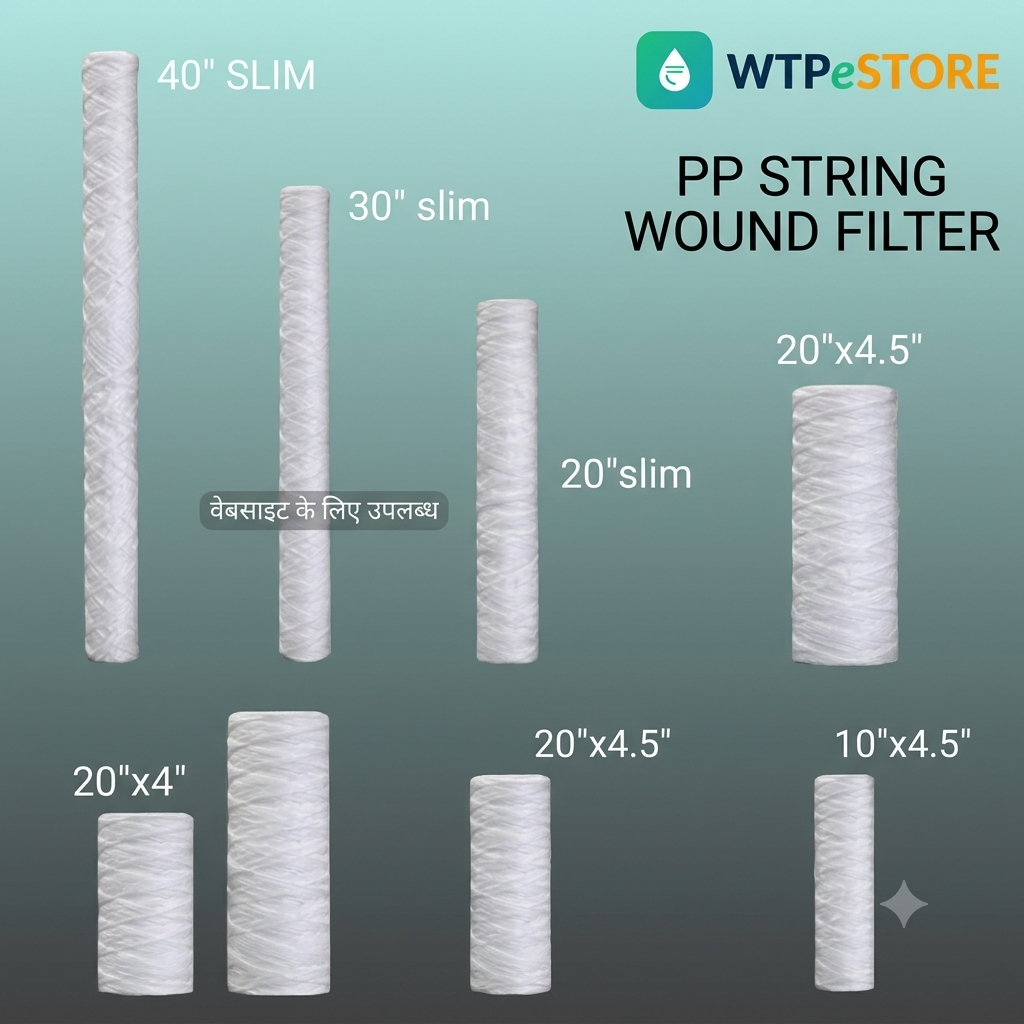
String wound
A yarn is wound over a core. This construction has the highest dirt holding capacity of the three.
Pleated
A membrane is folded like a concertina, giving a very large surface area in a small space.
Full comparison
| Feature | PP Spun | String Wound | Pleated |
|---|---|---|---|
| Price | Lowest | Slightly higher | Highest |
| Dirt capacity | Good | Best | Moderate |
| Flow rate | Good | Good | Highest |
| Washable and reusable | No | No | Yes (a few times) |
| Micron accuracy | Nominal | Nominal | Absolute available |
| Best suited to | General RO plants | Dirty water | High flow, reuse |
When to choose each
Choose PP spun if
- You have a general RO plant (250 to 5,000 LPH)
- Feed water is reasonable (borewell or municipal)
- You want the lowest cost
This covers about 90 percent of cases. See our cartridge filters range, starting at ₹100.
Choose string wound if
- The water carries a lot of silt or clay
- PP spun is choking every two to three weeks
- You want to reduce the labour of changing filters
String wound costs a little more but holds more dirt, so it lasts longer and total cost often falls.
Choose pleated if
- Flow is high and space is limited
- You want to wash and reuse the filter
- You need an absolute micron rating
Gopani filters
We also stock Gopani Clarywound, which is a higher quality filter in the string wound category. It performs well where dirt loading is high.
A common misconception
People assume an expensive filter means cleaner water. It does not — the micron rating determines what is retained, not the material. A 5 micron PP spun and a 5 micron pleated retain broadly the same particles.
Material only determines:
- How long the filter lasts
- How much flow can pass
- Whether it can be reused
Annual cost — the real comparison
Take a 1,000 LPH plant on moderately dirty water:
| Type | Unit price | Life | Per year | Annual cost |
|---|---|---|---|---|
| PP spun | ~₹105 | ~30 days | 12 | ~₹1,260 |
| String wound | ~₹210 | ~50 days | 7 | ~₹1,470 |
| Pleated (washed 3 times) | ~₹400 | ~30 days × 3 | 4 | ~₹1,600 |
Notice that the annual cost of all three is broadly similar. The difference is in effort:
- PP spun: 12 changes a year
- String wound: 7 changes a year
- Pleated: 4 purchases but 12 washes
So decide on convenience rather than cost. Where staff are present daily, PP spun is fine; where visits are infrequent, string wound is better.
Absolute pleated — a special case
Absolute pleated cartridges carry a guaranteed micron rating. They are used:
- In pharma and food industry
- Where the membrane is particularly expensive (8040 or seawater elements)
- Where validation or audit applies
On a general RO plant they are not necessary — nominal PP spun does the job.
The decision in 20 seconds
- General RO plant, reasonable water → PP spun 5 micron
- Dirty water, filter chokes quickly → string wound
- High flow, limited space → pleated
- You can wash filters → pleated
- Pharma or audit → absolute pleated
Which cartridge suits you?
Tell us your plant capacity, water type and how long your filters currently last, and we will suggest the best option.
💬 WhatsApp par poochhein 📞 9910646957Frequently asked questions
Which is better, PP spun or string wound?
For a general RO plant PP spun is adequate and cheaper. String wound holds more dirt so it lasts longer in dirty water, which reduces the effort of changing filters.
Can pleated filters be washed and reused?
Yes, three to five times. That is why despite the higher price they can work out cheaper over time. But you need the facility and the time to wash them.
Does an expensive filter give cleaner water?
No. What is retained is determined by the micron rating, not the material. A five micron PP spun and a five micron pleated retain broadly the same particles. Material determines how long the filter lasts and how much flow it passes.
When is an absolute pleated cartridge needed?
When a guaranteed micron rating is required, as in pharma or food industry, or where the membrane is particularly expensive. On a general RO plant it is not necessary and nominal PP spun is sufficient.
Which type works out cheapest?
Annual cost is broadly similar for all three. The difference is in effort — PP spun needs more frequent changing, string wound less frequent, and pleated needs washing. Choose according to your own convenience.