
What micron cartridge filter should you use
Short answer: 5 micron is the standard and correct choice ahead of an RO plant. If the feed water is dirty, fit 20 or 10 micron first and 5 micron after it, in two stages. Do not go straight to 1 micron — it chokes almost immediately and loads the pump.
Micron indicates how large a particle will be stopped. 5 micron means particles above 5 micrometres are retained. A human hair is about 70 micron thick, so 5 micron is roughly fourteen times finer.
Micron chart — what each stops
| Micron | What it stops | Where used |
|---|---|---|
| 100 | Coarse sand, leaves, insects | First screen |
| 50 | Sand, coarse silt | Very dirty borewell water |
| 25 | Silt, clay | Pre-filter, first stage |
| 20 | Clay, rust | First stage on dirty water |
| 10 | Fine clay, rust | Common pre-filter |
| 5 | Fine particles | Ahead of RO — the standard |
| 1 | Very fine particles | Final polishing |
| 0.45 / 0.22 | Down to bacteria | Pharma, laboratory, sterile |
The right setup for an RO plant
Good water (borewell, low turbidity)
A single stage is enough — 5 micron. That is adequate protection for the membrane.
Dirty water (high silt, river source, monsoon effect)
Use two stages:
- First: 20 or 25 micron — coarse particles are caught here
- Second: 5 micron — fine particles
What the wrong micron does
| Mistake | Consequence |
|---|---|
| Too fine (1 or 0.45) | Chokes immediately, pump overload, constant replacement, money wasted |
| Too coarse (50, 100) | Fine particles pass through and settle on the membrane |
| Single stage on dirty water | Filter has to be changed weekly |
Absolute vs nominal — an important distinction
- Nominal 5 micron: roughly 85 to 90 percent of particles are retained. Economical and fine for general use
- Absolute 5 micron: around 99.9 percent retained. Expensive, but guaranteed
For RO, nominal is sufficient. Absolute is needed where a guarantee is required — pharma work, or where the membrane is particularly expensive. The full comparison is in our absolute vs nominal guide.
By water type
| Feed water | Stage 1 | Stage 2 |
|---|---|---|
| Municipal supply | 5 micron | Not needed |
| Clean borewell | 5 micron | Not needed |
| Silty borewell | 20 micron | 5 micron |
| River water | Sand filter first | 20 plus 5 micron |
| Water with iron | Iron removal first | 20 plus 5 micron |
| Monsoon-affected | 25 micron | 5 micron |
For very dirty water a disc or screen filter should be fitted first — it is cleaned and reused, so cartridge cost falls.
How many cartridges — by flow
A single 10 inch cartridge handles roughly 500 to 1,000 LPH, depending on water quality. Above that:
- Use a longer cartridge — a 20 inch handles double
- Or a multi-round housing — 3, 5 or more cartridges together
- Or jumbo (big blue) — a thicker cartridge with more area
| Plant | Suggested |
|---|---|
| 250–500 LPH | One 10 inch, 5 micron |
| 1,000 LPH | One 20 inch or two 10 inch |
| 2,000 LPH | Jumbo 20 inch or a 3-round housing |
| 5,000 LPH and above | Multi-round SS housing |
Housing options are covered in our housing size guide.
Also consider
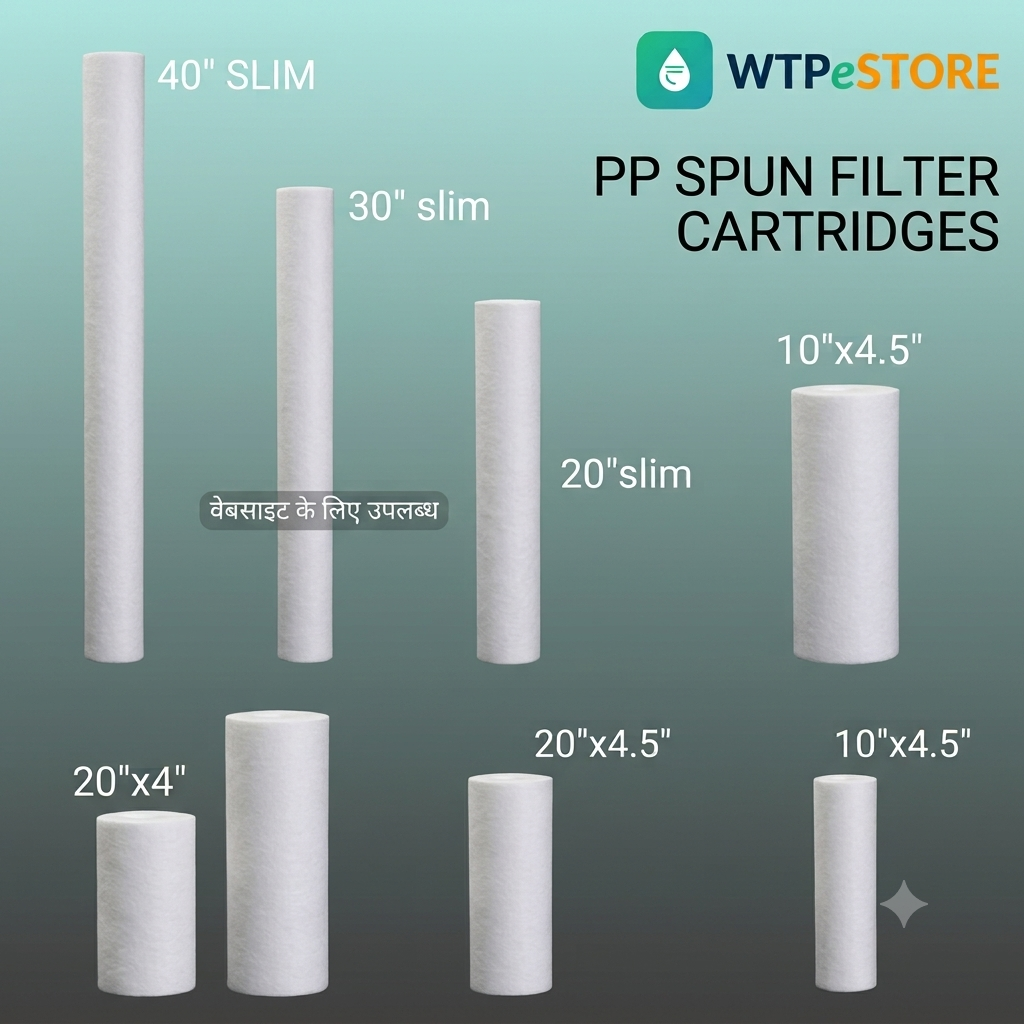
- Length: 10 inch or 20 inch, according to flow
- Diameter: standard (2.5 inch) or jumbo / big blue (4.5 inch)
- Material: PP spun, string wound or pleated — the full comparison is in our material guide
How to confirm the micron is right
Fit a pressure gauge before and after the filter (from ₹315). On a new filter the difference should be about 0.2 to 0.3 kg/cm².
- Large difference on a brand new filter → the micron is too fine, go coarser
- Very small difference but the membrane is fouling → the micron is too coarse, go finer
- Difference above 1 kg/cm² → time to change the filter
Those two gauges cost about ₹630 and tell you a great deal about plant health.
Get the right micron for your water
Send your feed water source, plant capacity and turbidity, and we will recommend the correct micron and staging.
💬 WhatsApp par poochhein 📞 9910646957Frequently asked questions
What micron filter does an RO plant need?
Five micron is the standard choice. If the water is dirtier, fit a twenty or twenty five micron filter first and five micron after it, so that the finer and more expensive filter lasts longer.
Is a 1 micron filter better?
No, for RO it is counterproductive. A one micron filter chokes very quickly, loads the pump and has to be replaced constantly. Five micron gives adequate membrane protection.
What is the benefit of two stage filtration?
The cheaper first filter catches the coarse material so the finer second filter lasts much longer. Total cost comes down and the pump is loaded less.
How do I know if the micron rating is right?
Fit pressure gauges before and after the filter. On a new filter the difference should be about zero point two to zero point three kg per cm2. A large difference on a brand new filter means the micron is too fine.
How much flow can one cartridge handle?
A ten inch cartridge handles roughly five hundred to one thousand LPH depending on water quality. For higher flows use a twenty inch cartridge, a jumbo size or a multi-round housing.