
STP technologies — MBBR, SBR and conventional compared
Short answer: All three use bacteria to treat sewage; the difference is how the bacteria are held and how the process is arranged. MBBR grows bacteria on floating plastic media, SBR does everything in one tank in timed phases, and conventional activated sludge uses separate tanks in a continuous flow.
For a building or housing society with limited space, MBBR or SBR is usually chosen. Conventional plants need more land but are simpler to operate.
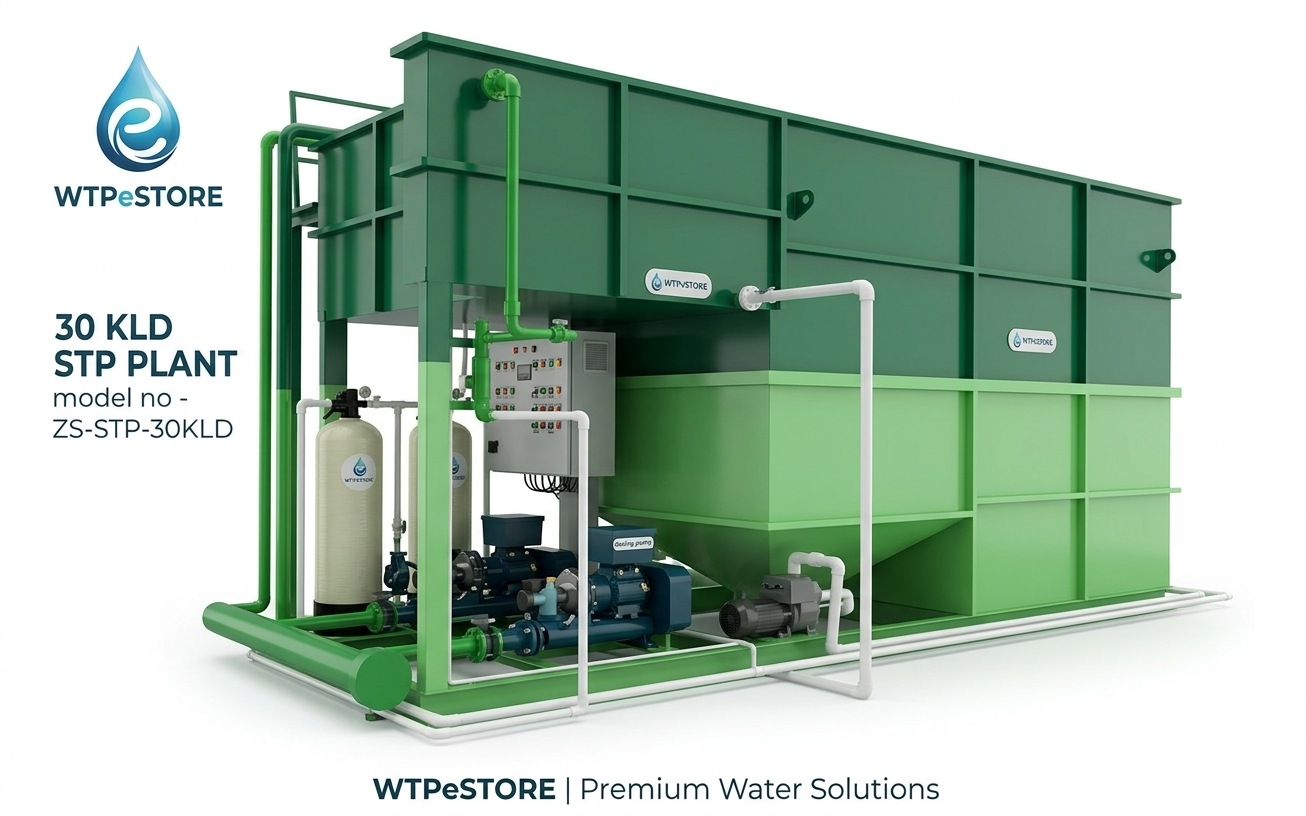
Conventional activated sludge
The traditional arrangement — separate tanks for each stage, with continuous flow through them:
Screening → equalisation → aeration → clarifier → filtration → disinfection
| Advantage | Limitation |
|---|---|
| Simple, well understood | Needs the most land |
| Easy to operate | Sensitive to load variation |
| Lower capital cost per tank | Larger civil works |
MBBR — Moving Bed Biofilm Reactor
Plastic carrier media floats in the aeration tank, and bacteria grow as a biofilm on the media surface rather than suspended in the water.
| Advantage | Limitation |
|---|---|
| Compact — much less space | Media cost |
| Handles load variation well | Media can be lost if screens fail |
| High biomass in a small tank | Requires good aeration for media movement |
| No sludge return needed | More complex than conventional |
Why it handles variation well: the biofilm stays attached to the media, so it cannot wash out during a high flow period the way suspended biomass can.
SBR — Sequencing Batch Reactor
Everything happens in one tank, in timed phases rather than in separate tanks:
- Fill — sewage enters
- React — aeration, bacteria consume the load
- Settle — aeration off, biomass settles
- Decant — clear water drawn off the top
- Idle — ready for the next cycle
| Advantage | Limitation |
|---|---|
| No separate clarifier needed | Requires reliable automation |
| Compact footprint | Batch process, needs buffering |
| Good nutrient removal possible | More instrumentation |
| Flexible cycle timing | Dependent on the control panel |
Comparison
| Feature | Conventional | MBBR | SBR |
|---|---|---|---|
| Space needed | Most | Least | Low |
| Handles load variation | Poorly | Well | Well |
| Operational complexity | Low | Moderate | Higher |
| Automation dependence | Low | Moderate | High |
| Sludge return | Required | Not required | Not required |
| Separate clarifier | Yes | Yes | No |
| Typical use | Large municipal | Buildings, societies | Buildings, hotels |
Which to choose
| Situation | Usually chosen |
|---|---|
| Housing society, limited basement space | MBBR |
| Hotel with variable occupancy | MBBR or SBR |
| Office building, weekday load only | SBR |
| Large municipal, land available | Conventional |
| Where operator skill is limited | MBBR (fewer moving parts than SBR) |
Monitoring — the same for all three
Whatever the technology, the biology has the same requirements:
| Parameter | Target | Instrument |
|---|---|---|
| pH | 6.5 – 8.5 | pH controller |
| DO in aeration | 1.5 – 3.0 mg/L (MBBR 2–4) | DO meter |
| Outlet turbidity | Below 10 NTU | Turbidity meter |
| Flow | Design load | Mag flow meter |
The electricity cost
In every design, the blower dominates the electricity bill — typically 60 to 70 percent of consumption. So DO monitoring is worthwhile regardless of technology.
In an SBR there is an additional saving available, because aeration is off during the settle and decant phases. Getting the cycle timing right therefore matters commercially as well as technically.
See our DO meter guide for the energy calculation.
Treated water reuse
Most STPs now feed the treated water to:
- Gardening and landscaping
- Toilet flushing
- Cooling tower make-up
- Floor and road washing
For reuse the tertiary stage matters — filtration and disinfection, and sometimes RO. Outlet quality monitoring becomes important because the water is going somewhere people encounter it.
Automation
All three need a control panel to sequence pumps and blowers, with SBR being the most dependent on it. Panel selection is covered in our ETP/STP panel guide.
STP instruments and monitoring
Send your plant KLD and technology, and we will recommend the instruments and control needed.
💬 WhatsApp par poochhein 📞 9910646957Frequently asked questions
What is the difference between MBBR and SBR?
MBBR grows bacteria as a biofilm on floating plastic media in a continuous flow arrangement. SBR does everything in one tank in timed phases of fill, react, settle and decant, so it needs no separate clarifier.
Which STP technology needs the least space?
MBBR generally needs the least, because the plastic media holds a high concentration of biomass in a small tank. SBR is also compact since it needs no separate clarifier. Conventional activated sludge needs the most land.
Why does MBBR handle load variation well?
The biofilm stays attached to the carrier media, so it cannot wash out during a period of high flow the way suspended biomass can in a conventional plant.
What is the main risk with an SBR?
It depends entirely on its control panel for sequencing. If the automation fails, the whole plant stops. Panel quality and keeping spares matter more here than with other designs.
What dominates the electricity cost of an STP?
The blower, typically sixty to seventy percent of consumption, regardless of which technology is used. That is why dissolved oxygen monitoring is worthwhile in every design.