
Turbidity and NTU — what level is acceptable
Short answer: Turbidity is the cloudiness of water — how many particles are suspended in it — measured in NTU. Drinking water should be below 1 NTU, and water going to an RO membrane must be below 5 NTU.
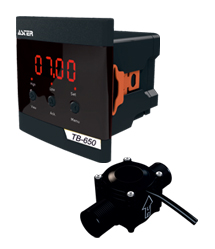
An online meter, the TB 650, costs ₹60,375. That is a lot, so it is only justified where a continuous record is genuinely required.
What turbidity actually is
Water carries suspended silt, clay, algae and organic particles. These scatter light, and turbidity is derived by measuring that scattering. More scattering means higher NTU.
Note that turbidity is different from TDS. TDS is dissolved salts, which are invisible; turbidity is suspended particles, which you can see. Water can have high TDS and still look perfectly clear.
Acceptable NTU levels
| Water | NTU |
|---|---|
| Drinking water (BIS) | Below 1 (maximum 5) |
| RO feed (before the membrane) | Below 5, essential |
| UF feed | Below 5 |
| Borewell (typical) | 1 – 10 |
| River water | 10 – 500 (higher in monsoon) |
| ETP outlet | Below 10 (as per norms) |
| STP outlet | 5 – 10 |
How to reduce turbidity
| NTU | What to install |
|---|---|
| Below 10 | Cartridge filter (5 or 10 micron) |
| 10 – 50 | Multigrade or sand filter, then cartridge |
| 50 – 200 | Coagulation, settling, then filtration |
| Above 200 | Full clarification system |
To remove coarse particles first, a disc or screen filter is worth fitting — it is cleaned and reused, so it reduces cartridge consumption.
SDI — more important than turbidity for RO
NTU alone is not sufficient for RO. There the relevant measurement is SDI (Silt Density Index), which detects very fine particles that a turbidity meter misses entirely.
| SDI | Interpretation |
|---|---|
| Below 3 | Good for RO |
| 3 – 5 | Acceptable, but improve pre-treatment |
| Above 5 | Membrane will foul quickly — fix pre-treatment first |
SDI is measured with an SDI kit with 50 filter papers (₹5,565), with refill papers at ₹1,890 per 50. That is far cheaper than an online meter and far more relevant to RO.
When an online turbidity meter is justified
The TB 650 (₹60,375) makes sense when:
- Municipal or packaged water plant — a continuous record is required
- ETP or STP discharge — pollution board requirement
- Feed water quality varies — river water, where NTU spikes in the monsoon
- Tracking filter performance — so you know automatically when a filter has choked
It comes with RS485 or 4-20mA output, so data can go to a datalogger or a panel.
When it is not needed
- Stable borewell water where NTU is consistently low
- A small RO plant, where an SDI kit and cartridge pressure drop tell you enough
- Anywhere with no record-keeping requirement
The cheap alternative: fit pressure gauges before and after the cartridge filter. When the difference starts rising, the filter is choking — for about ₹630.
Installation points
- Steady flow required — bubbles corrupt the reading, so provide venting
- Keep out stray light — external light reaching the sensor causes errors
- Clean it — film on the optical window makes readings drift upward. Clean monthly
- Calibrate against a formazin standard every 3 to 6 months
A practical observation
We often see plants with a turbidity meter fitted that has never been calibrated. Such a meter gives false confidence, which is worse than having none at all. If you cannot arrange calibration, spend the money on better pre-treatment and SDI testing instead.
Get your pre-treatment designed
Send us your feed water source and turbidity, and we will advise on the right filtration and SDI testing.
💬 WhatsApp par poochhein 📞 9910646957Frequently asked questions
What is the difference between turbidity and TDS?
Turbidity is suspended particles that make water look cloudy, while TDS is dissolved salts which are invisible. Water can have high TDS and still look completely clear, and the reverse is also possible.
What turbidity is acceptable for an RO plant?
Below five NTU. Above that the membrane fouls very quickly. For RO the SDI test is even more important and should be below three.
What is SDI and why does it matter?
SDI stands for silt density index. It detects very fine particles that a turbidity meter misses, which makes it more relevant to RO than turbidity. An SDI kit also costs far less than an online meter.
When should an online turbidity meter be installed?
Where a continuous record is required, such as a municipal or packaged water plant, or where feed water quality varies as with river water. On a small plant with stable borewell water it is not necessary.
How often should a turbidity meter be calibrated?
Every three to six months against a formazin standard, with the optical window cleaned monthly. An uncalibrated meter gives false confidence, which is worse than having no meter at all.