
FT-650 insertion vs full bore — which type to choose
Short answer: Choose full bore for lines up to 50NB — all the water passes through the meter so the reading is more reliable. Choose insertion for lines above 40NB, where a sensor is inserted through a small tapping in the pipe and the cost is far lower than a full bore meter of that size.
At 40NB and 50NB both options exist, so that is where the decision needs some thought.
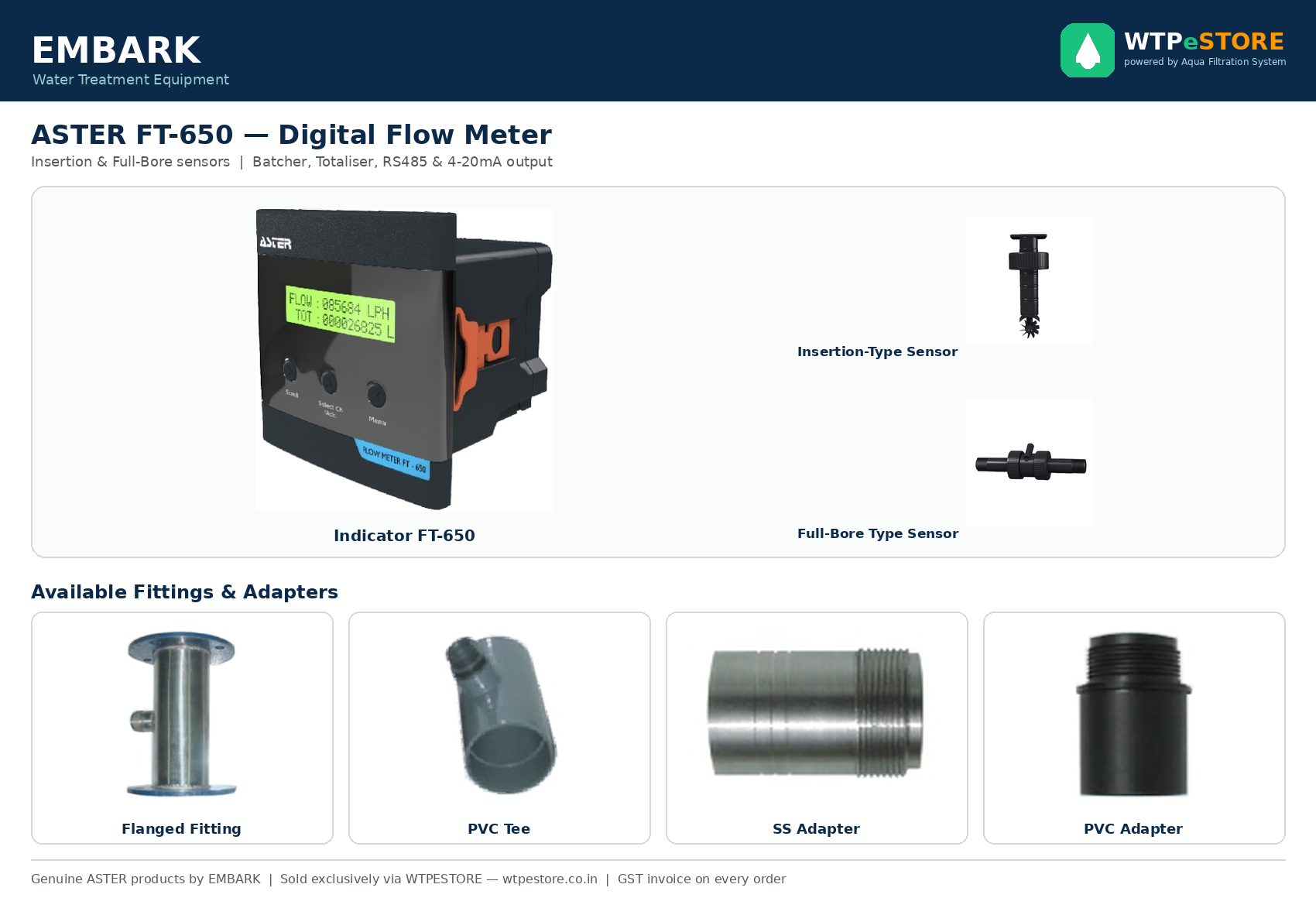
The basic difference
Full bore — all water through the meter
The meter is itself a section of pipe that joins into the line, so the entire flow passes through the sensor. The reading is of the whole line, not an estimate.
Insertion — only the sensor inside
A tapping is made in the pipe, an adaptor is welded or threaded on, and a sensor is inserted through it. The sensor measures velocity at one point and the meter calculates total flow from that.
Comparison
| Feature | Full bore | Insertion |
|---|---|---|
| Line size | 20NB – 50NB | 40NB – 200NB |
| Cost on large lines | Very high | Much lower |
| Accuracy | Better | Good, but depends on installation |
| Fitting | Line must be cut | Tapping plus adaptor |
| Servicing | Line must be shut down | Sometimes without shutdown |
| Pressure drop | Slight | Negligible |
| Starting price | ₹10,500 | ₹12,600 plus fittings |
Full bore models
| Size | Range (LPH) | Price | Page |
|---|---|---|---|
| 20NB | 100 – 2,000 | ₹10,500 | View |
| 25NB | 250 – 8,000 | ₹10,500 | View |
| 50NB | 1,000 – 30,000 | ₹12,600 | View |
Sensors are also available separately: 20NB (₹2,205), 25NB (₹2,415) and 50NB (₹4,725).
Insertion models and the fittings you also need
An insertion installation needs three items — the meter, the sensor and the adaptor. People often order only the meter and then discover the fittings are separate.
| Item | For line size | Price | Page |
|---|---|---|---|
| FT-650 insertion | 40/50/65/80NB | ₹12,600 | View |
| FT-650 insertion | 100/125/150NB | ₹13,650 | View |
| FT-650 insertion | 200NB | ₹14,700 | View |
| Regular sensor | 40–80NB | ₹4,830 | View |
| Long body sensor | 100–125NB | ₹5,460 | View |
| Extra long sensor | 150–200NB | ₹6,195 | View |
| SS 304 weldon adaptor | For welding to the pipe | ₹1,575 | View |
Why sensor length matters
The sensor must reach the correct depth inside the pipe, usually around the centre. A short 40NB sensor will not reach the middle of a 100NB pipe, so a long body version is required, and 150NB or 200NB needs an extra long body.
This is why the exact pipe NB must be stated when ordering — saying only "it is a large line" is not enough to select the right sensor.
Four installation essentials for insertion type
- Correct depth — the sensor should reach the middle of the pipe. Too shallow or too deep both give wrong readings.
- Straight pipe — 10 diameters upstream and 5 downstream. This matters even more than with a full bore meter.
- Pipe must be full — a partly full pipe gives a wrong reading.
- Sensor orientation — there is a mark on the sensor that must point in the direction of flow.
The decision in one line
- 20NB – 25NB line: full bore, no debate
- 40NB – 50NB line: full bore if accuracy matters most, insertion if cost matters most
- 65NB and above: insertion is the only practical choice
- Very dirty water: consider an electromagnetic meter instead of either
We will pick insertion or full bore for you
Send your pipe NB, flow and whether accuracy or cost matters more. We will quote the complete set including sensor and adaptor.
💬 WhatsApp par poochhein 📞 9910646957Frequently asked questions
What extra items are needed with an insertion type meter?
You need the correct length of sensor and an SS 304 weldon adaptor in addition to the meter itself. The product description says without fitting, which means the adaptor is supplied separately. Ordering all three together avoids delays at installation.
Why is a full bore meter more accurate?
Because the entire flow passes through the sensor, so what is measured is the actual flow. An insertion sensor measures velocity at a single point and calculates the total from it, which makes it more sensitive to installation errors.
Can an insertion sensor be removed without shutting the line?
In some installations with an isolation valve this is possible, but it depends on how the adaptor is fitted. Usually the line has to be shut for cleaning or replacement, so providing a bypass is sensible.
Which sensor is needed for a 100NB pipe?
A long body insertion sensor, which covers 100NB and 125NB. A standard sensor will not reach the centre of a pipe that size and the reading will be wrong. For 150NB and 200NB an extra long body sensor is required.
How do I connect an FT-650 to a control panel?
You need the version with a 4-20mA or RS485 output, which is an add-on of around four thousand rupees. From there the data can be taken to a panel, PLC or datalogger.