
What RO antiscalant does and how much to dose
Short answer: Antiscalant stops calcium, magnesium and other salts from crystallising onto the membrane surface. It does not remove hardness — it keeps the salts in solution long enough to leave with the reject stream. The usual dose is 3 to 5 ppm on feed water.
Without it, a plant on hard water can scale a membrane within weeks. See our ZeroScale RO antiscalant.
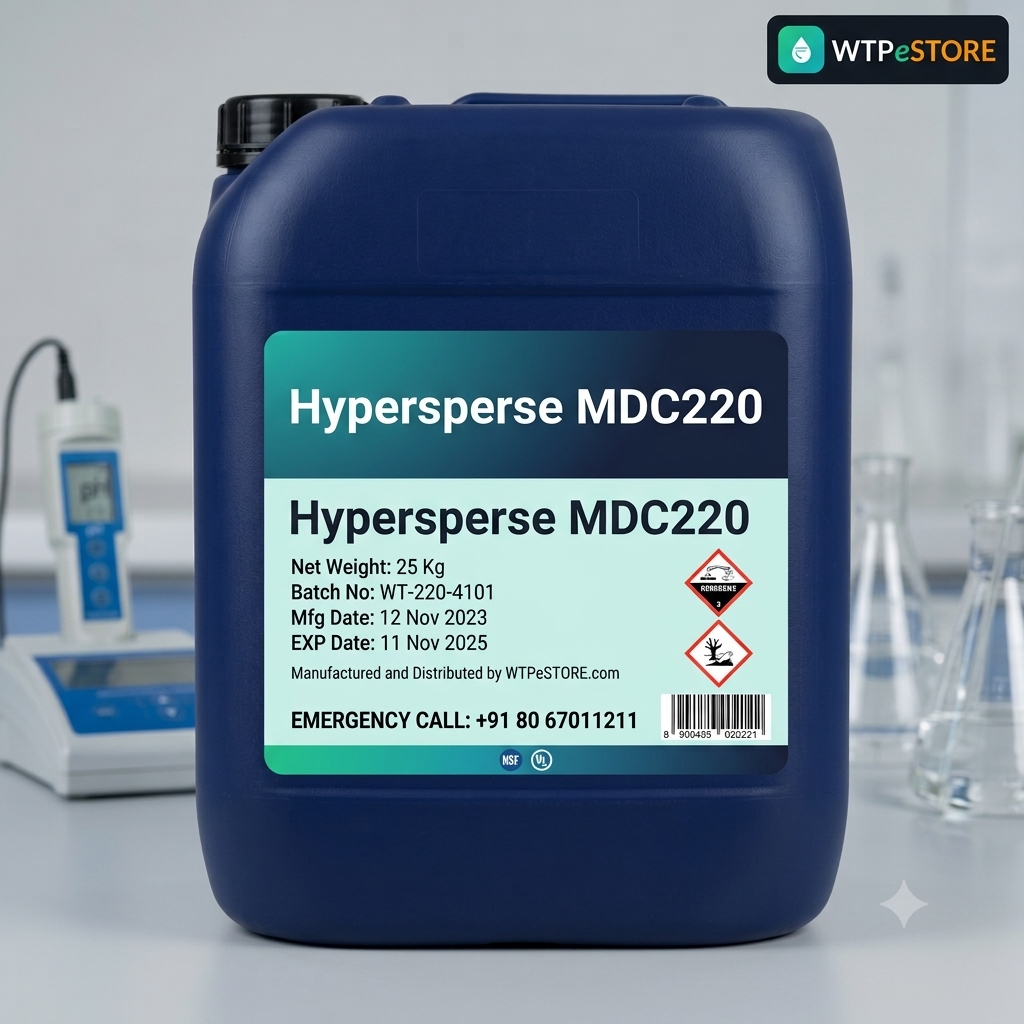
How it works
In an RO plant the reject stream becomes progressively more concentrated. At some point calcium carbonate and similar salts exceed their solubility and begin to crystallise — and they crystallise on the nearest surface, which is the membrane.
Antiscalant works in three ways:
- Threshold inhibition — it delays crystals forming even above saturation
- Crystal distortion — any crystals that do form grow irregularly and do not adhere well
- Dispersion — particles are kept suspended and carried out with the reject
Dose by feed TDS
| Feed TDS | Hardness | Dose (ppm) |
|---|---|---|
| Below 500 | Low | 2 – 3 |
| 500 – 1,500 | Moderate | 3 – 4 |
| 1,500 – 3,000 | High | 4 – 5 |
| Above 3,000 | Very high | 5 – 6, confirm by analysis |
Working out the quantity
Example: 770 LPH feed at 4 ppm → 3.08 grams per hour, about 74 grams a day. A 25 kg drum then lasts roughly 11 months.
The full calculation including solution strength and pump setting is in our dosing calculation guide.
Where to inject
After the cartridge filter, before the high pressure pump. The reasons:
- Injected before the cartridge, the chemical is trapped by the filter
- Injected after the HP pump, you need an expensive high pressure dosing pump
- In between, it mixes properly and reaches the membrane
What happens without antiscalant
- Weeks 1 to 4: scale begins forming, particularly on the last element
- Months 1 to 3: permeate flow falls, feed pressure rises
- Months 3 to 6: CIP cleaning recovers only part of the performance
- Beyond: membrane replacement
The chemical cost is small compared with a set of membranes, which is why this is never a sensible economy.
Checking it is actually working
The most common failure is not the chemical but the dosing stopping unnoticed:
- Mark the tank level — check weekly that it is falling
- Fit a level switch (₹1,050) so the pump stops when the tank empties
- Watch permeate flow and pressure — the first sign of scaling
- Verify the pump output occasionally by measuring into a jar
Solution handling
- Make up a 5 to 10 percent solution — see our calculation guide
- Do not keep solution more than 15 to 20 days, as bacteria can develop
- Use a LLDPE dosing vessel — not an improvised container
- Keep the tank covered and mounted above the pump
Choosing the right antiscalant
Different formulations suit different water chemistry:
| Water condition | Consideration |
|---|---|
| High calcium carbonate | Standard antiscalant |
| High sulphate | Formulation matters more |
| High silica | Specific silica inhibitor needed |
| Iron present | Dispersant properties important |
Send us your water analysis and we will recommend the correct product from our ZeroScale RO chemicals range.
Does more dose help?
No. Beyond the recommended rate there is no additional protection, and excess antiscalant can itself deposit on the membrane and act as a foulant. It also wastes money.
Stay at the calculated dose and spend the attention on making sure the dosing actually happens — that is where plants really lose membranes.
Need antiscalant?
Send your feed TDS, hardness and plant capacity, and we will recommend the right product and dose.
💬 WhatsApp par poochhein 📞 9910646957Frequently asked questions
What does RO antiscalant actually do?
It prevents calcium, magnesium and other salts from crystallising onto the membrane surface, by delaying crystal formation, distorting any crystals that do form, and keeping particles dispersed so they leave with the reject stream.
Does antiscalant remove hardness?
No. It keeps salts in solution during the short time water is inside the membrane element, but the hardness is still there. If you need hardness removed, a softener is required.
How much antiscalant should be dosed?
Usually three to five ppm on feed water. Two to three ppm for low TDS feed and five to six ppm above three thousand TDS. The dose applies to feed flow, not to plant output.
What happens if the antiscalant runs out unnoticed?
Scaling begins within weeks, permeate flow falls and feed pressure rises, and within a few months cleaning may only partly recover performance. A level switch on the dosing tank prevents this at very low cost.
Is a higher dose better?
No. Beyond the recommended rate there is no additional protection, and excess antiscalant can itself deposit on the membrane and act as a foulant, as well as wasting money.