
Top mount vs side mount vessel — which to choose
Short answer: On a top mount vessel the valve sits on the top opening, which is the usual arrangement for smaller vessels and needs headroom above. On a side mount the valve is fitted to a side opening, which suits larger vessels and works where headroom is limited.
The choice affects not just the vessel but also which multiport valve you can use, so it must be decided before ordering.
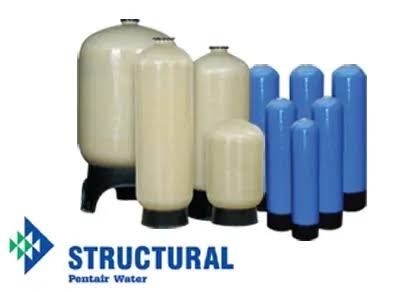
The difference
Top mount
The vessel has a threaded opening on top, and the valve screws directly into it. The riser pipe runs up the centre of the vessel into the valve.
Side mount
The vessel has a flanged opening on the side, usually near the top, and the valve bolts on there. The internal piping is arranged accordingly.
Comparison
| Feature | Top mount | Side mount |
|---|---|---|
| Usual sizes | 0844 to 2160 | 1665 and above |
| Headroom needed | More (valve sits on top) | Less |
| Valve cost | Lower | Higher |
| Media loading | Through the top opening | Through the top manway |
| Servicing | Valve must come off to open | Easier access |
| Flow capacity | Limited by the opening size | Higher |
When to choose top mount
- Vessel size up to about 2160
- There is headroom above the vessel
- You want the more economical option
- Flow is within what the top opening can pass
This covers most domestic and commercial softeners and filters.
When to choose side mount
- Larger vessels, generally 1665 and above
- Headroom is limited — a basement, or under a low ceiling
- Higher flow than a top opening can carry
- Frequent access to the vessel interior is expected
Headroom — measure before ordering
This catches people out. A top mount vessel needs clearance above it for the valve, and also for removing the valve later.
| Vessel | Vessel height | Total height needed |
|---|---|---|
| 1054 | 54" | ~66" (5.5 ft) |
| 1354 | 54" | ~66" (5.5 ft) |
| 1665 | 65" | ~78" (6.5 ft) |
| 2160 | 60" | ~74" (6.2 ft) |
| 2469 | 69" | ~84" (7 ft) |
Add roughly 12 inches above the vessel for the valve, plus room to work. If that is not available, choose side mount.
The opening sizes
Top openings come in two common thread sizes:
- 2.5 inch — smaller vessels, lower flow
- 4 inch — larger vessels, higher flow
The valve must match. Where they differ, an adaptor 2.5 x 4 for top mounted MPV (₹210) is used.
How it affects valve selection
Multiport valves are made specifically for top mount or side mount — they are not interchangeable. So decide the mounting before ordering the valve.
Valve selection is covered in our MPV guide, and the code system in our MPV code guide.
The distribution system also differs
Top mount vessels use a riser pipe with a top distributor and bottom laterals. Options include the RM ST1101 top distribution (₹788) and lateral assemblies such as the RM ST6101 with 6 long laterals (₹2,520).
Larger vessels use hub and lateral arrangements such as the 6450 for a 2472 vessel (₹1,575) or the 6600 for a 3072 vessel (₹1,575). See our distribution guide.
Other fittings you will need
- In/out adaptor with 20NB inlet and outlet — ₹578
- Vacuum breaker / air release valve 25NB — ₹210, which prevents the vessel collapsing under vacuum when it drains
- Brine director 15NB — ₹1,312, for softeners
What to tell us when ordering
- Vessel size required
- Available headroom in feet
- Flow in LPH
- Application — softener or filter
- Whether the valve is manual or automatic
Top or side mount — we will advise
Send your vessel size, available headroom and flow, and we will confirm the mounting and matching valve.
💬 WhatsApp par poochhein 📞 9910646957Frequently asked questions
What is the difference between top mount and side mount?
On a top mount vessel the valve screws into an opening on top, which is usual for smaller vessels and needs headroom above. On a side mount the valve bolts to a side opening, which suits larger vessels and works where headroom is limited.
How much headroom does a top mount vessel need?
Roughly twelve inches above the vessel for the valve, plus room to work. So a 1665 vessel of sixty five inches needs about six and a half feet of total height. If that is not available, choose side mount.
Can a top mount valve be used on a side mount vessel?
No, multiport valves are made specifically for one or the other and are not interchangeable. That is why the mounting arrangement has to be decided before ordering the valve.
What is the difference between 2.5 inch and 4 inch openings?
They are the thread size of the top opening. Smaller vessels with lower flow use two and a half inch, and larger vessels four inch. Where the valve and vessel differ, an adaptor is available.
Why is a vacuum breaker needed?
If a vessel drains and air cannot enter, the resulting vacuum can deform the vessel or draw media into the pipework. A vacuum breaker or air release valve prevents this and costs very little.