Four chemicals for open recirculating cooling systems — one for scale and corrosion, two biocides that alternate, and an algaecide for the basin. Together they keep heat transfer where it should be.
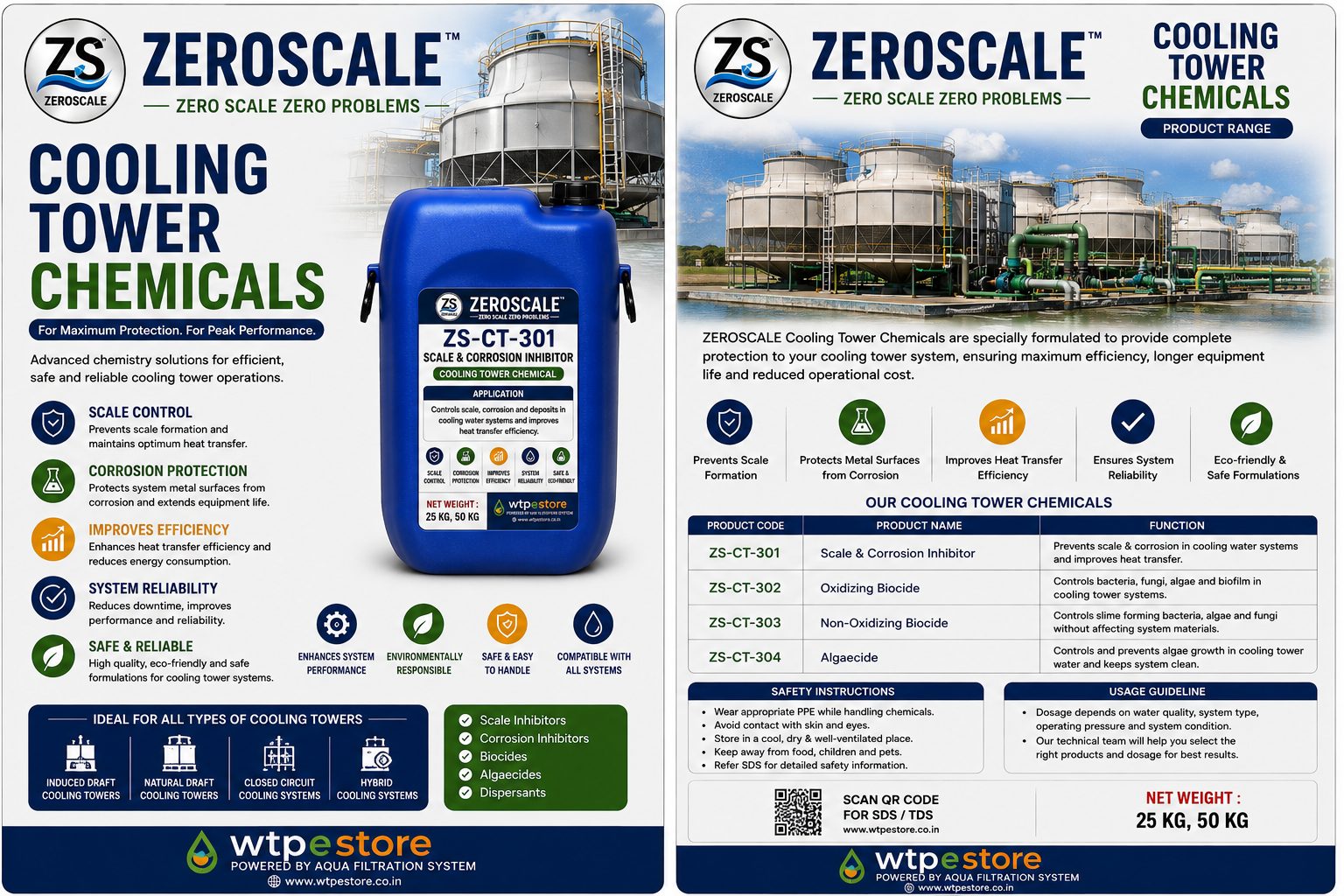
A cooling tower works by evaporating water. Salts do not evaporate — they stay behind and concentrate cycle after cycle, until calcium carbonate reaches saturation and deposits exactly where it hurts most: on the hot heat-exchanger surfaces where transfer efficiency matters.
At the same time the water is fully aerated by design, because it has just been sprayed through air. Oxygen-saturated water is corrosive to the mild steel and copper in the circuit, and pitting develops in the tubes while corrosion products circulate and settle as deposits of their own.
The third front is biological. Warm water, sunlight on the basin, and air drawn through the tower delivering dust and organisms make a cooling tower close to a purpose-built incubator. Algae blocks distribution nozzles; biofilm inside heat-exchanger tubes insulates far more effectively than mineral scale — a film a fraction of a millimetre thick can cut heat transfer more than scale several times thicker.
The three problems feed each other. Deposits create oxygen-concentration cells that accelerate corrosion underneath. Corrosion debris gives scale somewhere to anchor. Biofilm shelters both from the inhibitors meant to stop them. This is why cooling tower treatment is always a programme, never a single chemical.
Click any product for full specification, dosing guidance and FAQs.
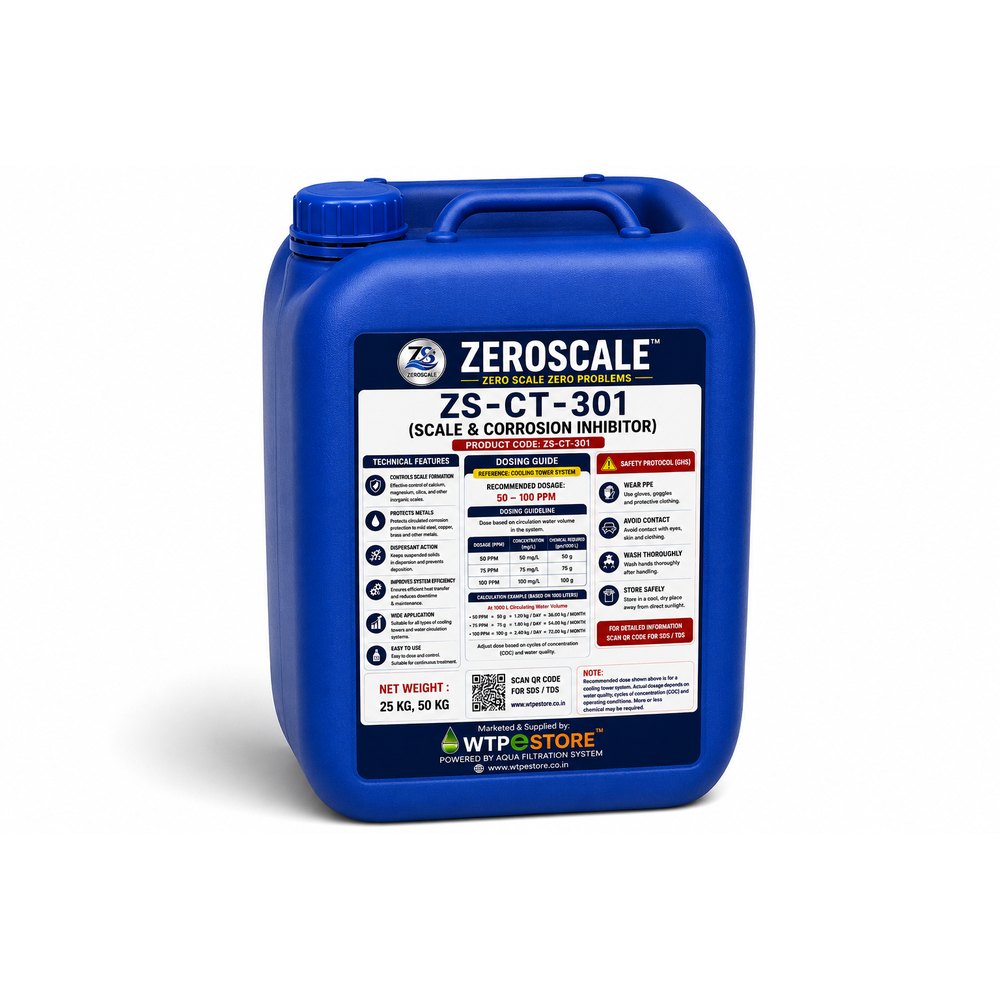 ZS-CT-301
Multi-functional formulation that controls scale and protects mild steel and yellow metals across the whole circuit.
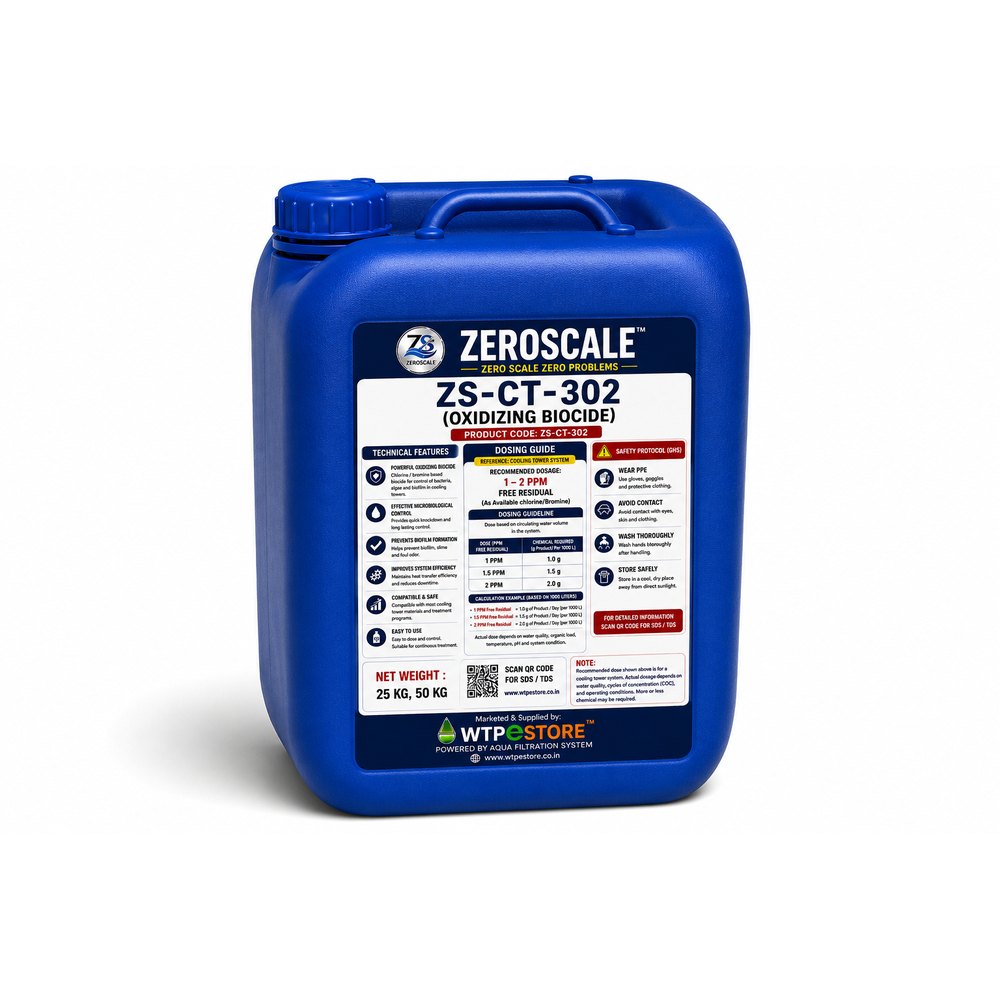 ZS-CT-302
Chlorine/bromine based routine control of bacteria and algae. Maintained as a free residual in circulating water.
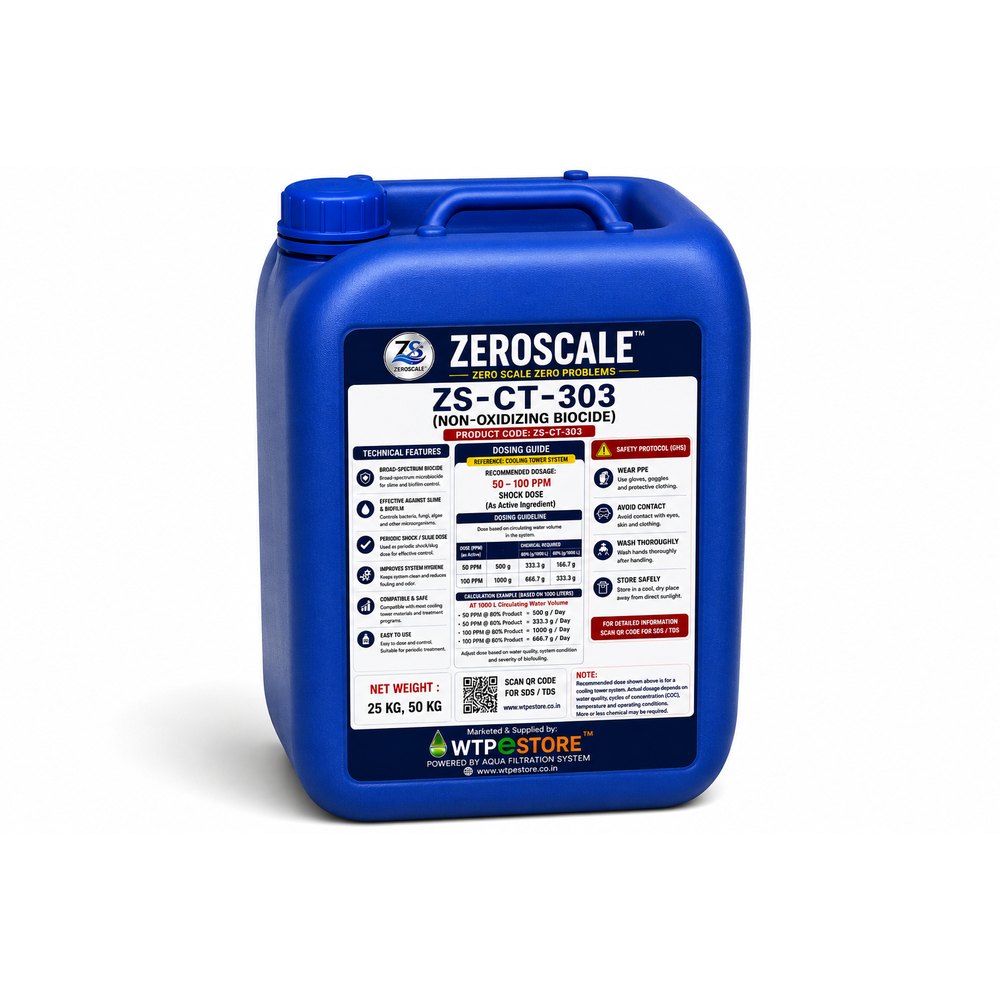 ZS-CT-303
Broad-spectrum shock dose that penetrates established biofilm — reaching organisms oxidising biocide cannot.
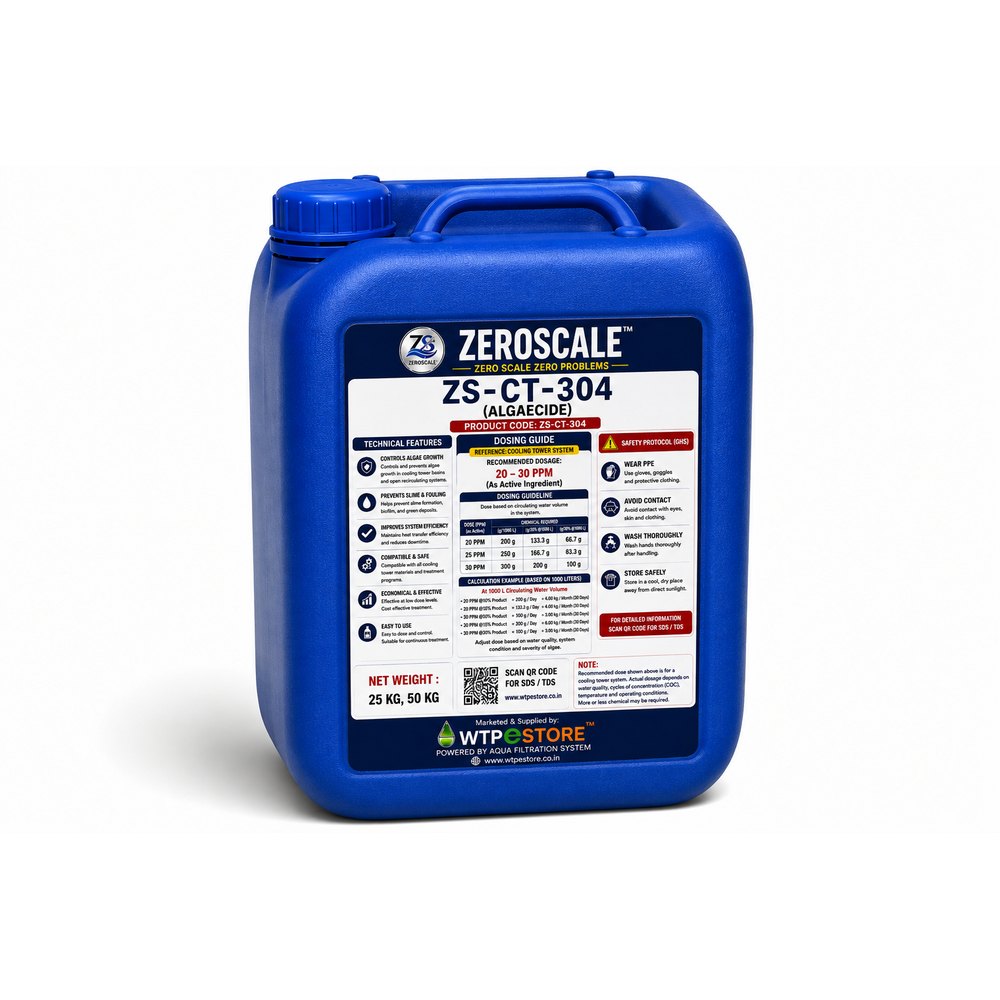 ZS-CT-304
Targeted control of algae in basins, on distribution decks and across fill packing where sunlight reaches wet surfaces.
Start from the symptom you are seeing — it usually points straight to the chemical.
| What you are seeing | What it points to |
|---|---|
| Approach temperature rising for same load | Scale or fouling on exchanger surfaces — dose scale & corrosion inhibitor |
| Pitting or rust in the circuit | Aerated water attacking metal — same inhibitor carries corrosion protection |
| Green growth on basin and deck | Algae — dose algaecide and clean the basin physically |
| Slime on surfaces, rising bacterial counts | Biofilm — routine oxidising biocide plus non-oxidising shock |
| Heat transfer poor but scale readings normal | Biofilm insulating the tubes — shock dose with non-oxidising biocide |
| Free residual reads zero between doses | Biocide fully consumed — review dose rate and organic load |
Scale and corrosion inhibitor, dosed against circulating water volume and topped up as blowdown removes it.
Oxidising biocide for routine control, non-oxidising as a periodic shock. Alternating stops organisms adapting to one chemistry and reaches biofilm that oxidising alone cannot.
Algaecide more often through summer, when sunlight and warmth accelerate growth. Clean the basin physically after treating.
Cycle control. Blowdown sets how far the water concentrates. Chemical treatment widens the safe range — it does not remove the ceiling your make-up water sets.
Scale and corrosion inhibitor running continuously, plus a biocide programme — oxidising for routine control, non-oxidising for periodic shock. Add algaecide for open basins exposed to sunlight.
How many times the circulating water has concentrated relative to make-up — measure conductivity of both and divide. Higher cycles save water but push you closer to scaling. Your make-up water quality sets a practical limit; send us the analysis and we will tell you what it is.
Oxidising biocide is consumed at the surface of a biofilm and never reaches the organisms inside it. Non-oxidising chemistry penetrates the film. Alternating also prevents populations adapting to a single chemistry.
It is calculated on system holding volume — basin, piping and exchangers together — not tower tonnage alone. Send us your holding capacity and make-up water report and we will work out dose and monthly consumption.
Conductivity and inhibitor residual weekly at minimum, along with pH and hardness. Biocide free residual should be checked more often — daily where possible.
Only up to the limit your make-up water allows. Beyond that the circulating water concentrates past saturation and scales regardless of dose. Chemical treatment raises the ceiling; it does not remove it.
Send us your water analysis, system capacity and running hours — we will work out which chemicals you need, at what dose, and what it costs per month.
